Table of Contents
- 1. Complete a Thorough Pre-Drive Vehicle Inspection
- 2. Master Parallel Parking and Essential Maneuvers
- 3. Understand Common Road Test Mistakes to Avoid
- 4. Manage Driving Test Anxiety: Tips for Test Day
- 5. How to Prepare for DMV Road Test: Key Strategies
- 6. What to Expect During a DMV Road Test
- 7. Practice Defensive Driving and Hazard Awareness
- Why Professional Road Test Preparation Matters
- Frequently Asked Questions
Last Updated: September 23, 2026
1. Complete a Thorough Pre-Drive Vehicle Inspection
A proper pre-drive vehicle inspection is mandatory, it’s an automatic fail point on the DMV road test. Before starting the engine, walk around the vehicle and check critical safety features.
Walk around the vehicle and check all lights (headlights, brake lights, turn signals, hazard lights), windshield condition, mirror adjustment, and tire tread and inflation. Do this methodically, not rushed.
Inside, adjust your seat, all mirrors, and steering wheel. Test the horn, wipers, washer fluid, and parking brake. These two-minute checks demonstrate vehicle safety knowledge.
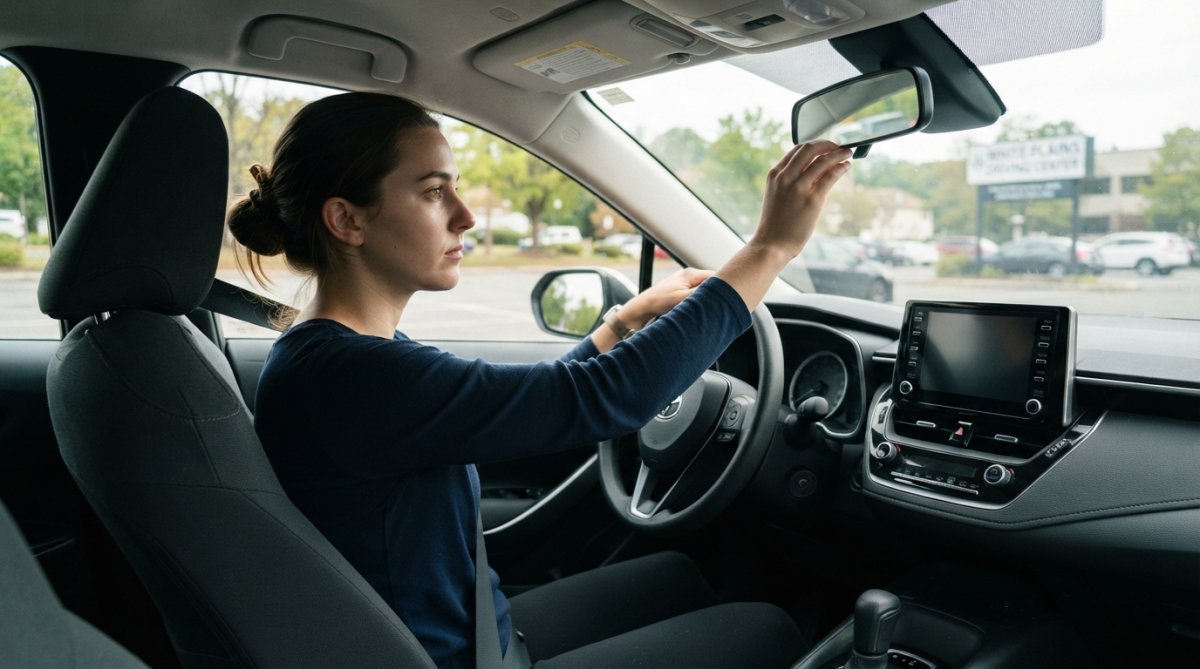
The examiner watches whether you perform these checks unprompted, foundational defensive driving. Many nervous test-takers skip this, but slowing down here sets the tone for the entire test.
Document your inspection mentally or on paper before your test. Know which lights to check, which mirrors to adjust, and in what order. Muscle memory helps when nerves kick in.
2. Master Parallel Parking and Essential Maneuvers
Parallel parking demonstrates precise vehicle control, spatial awareness, and composure under pressure. Mastering it immediately boosts confidence.
For a space 1.5 times your vehicle’s length, pull alongside the front car with 2 feet distance. Turn the wheel fully right and back up to a 45-degree angle. Straighten, continue backing, then turn left and adjust forward to center. This requires substantial practice.
The three-point turn is equally critical. Pull right, turn wheel fully left and drive forward to an angle. Reverse with wheel fully right. Drive forward with wheel left to complete the 180-degree turn smoothly without hitting the curb.
Practice lane changes constantly: signal for at least three seconds, check mirrors and blind spots, move gradually. Many automatic fails result from insufficient signaling or skipped blind spot checks.
The examiner is grading your ability to control the vehicle precisely and smoothly, not your speed. Slow, deliberate movements score higher than quick, jerky ones.
3. Understand Common Road Test Mistakes to Avoid
Automatic fail mistakes can be eliminated with advance knowledge. The most common: rolling stops instead of complete stops. The car must be motionless for at least one second before proceeding.
Failing to signal is an automatic fail. Signal for at least three seconds before every turn and lane change, count to three before moving.
Hitting a curb during parallel parking or a three-point turn is an automatic fail. Extensive practice develops a feel for your vehicle’s dimensions.
Not checking mirrors and blind spots before turning or changing lanes is an automatic fail. The examiner watches your eyes to confirm you’re actually looking.
Speeding or driving too slowly can result in a fail. Stay within the posted speed limit and maintain consistent pace.
Not yielding right of way is an automatic fail. At four-way stops, the first car arrives first; simultaneous arrivals go to the right. Yield to pedestrians and vehicles in the intersection when lights turn green.
Stalling the engine during the test is not an automatic fail, but it significantly damages your score. Practice starting smoothly without jerking or revving the engine.
4. Manage Driving Test Anxiety: Tips for Test Day
Test anxiety affects performance. Your body’s stress response can override training, so you need strategies to stay calm.
Get eight hours of sleep the night before; don’t cram practice. Eat a normal breakfast on test day. Arrive 15 minutes early to avoid rushing.
Before the test, breathe in for four counts, hold for four counts, exhale for four counts, repeat five times to activate your parasympathetic nervous system.
The examiner wants you to pass and understands nervous drivers make small mistakes. If you make one error, acknowledge it and move forward, one mistake doesn’t fail you.
Use positive self-talk during the test. Replace “I’m going to mess up” with “I’ve practiced this and I can do it.” Confidence comes from preparation.
If overwhelmed, ask the examiner for a moment to collect yourself. A brief pause prevents panic and multiple errors.
Practice your test route beforehand if possible. Familiarity with the road reduces anxiety because your brain doesn’t have to process an unfamiliar environment while you’re also being tested.
5. How to Prepare for DMV Road Test: Key Strategies
Preparation is the antidote to anxiety. A structured plan removes guesswork and builds confidence systematically.
Take the DMV written test to ensure you understand traffic laws and road signs. The examiner may ask questions about traffic laws during your road test.
Get 40-50 hours of supervised driving practice across different times of day, weather conditions, and road types (highways, residential streets, busy intersections). Research shows this significantly increases pass rates.
Schedule professional driving lessons with a certified instructor to identify bad habits and learn specific maneuvers examiners grade. White Plains Driving Center provides expert driving instruction for students of all levels, from beginners to advanced drivers, serving the Westchester area since 1978. With DMV-certified instructors and flexible scheduling, we specialize in building confidence for nervous drivers, adults, and international students alike. Our comprehensive packages include pre-licensing classes and road test support to ensure you are fully prepared to drive with confidence.
Practice the specific route your test will follow if you can. Many DMV locations have standard test routes. Ask your instructor or the DMV office which roads they typically use. Driving these routes beforehand removes the surprise factor and lets you practice hills, tight turns, and other challenging sections.
Create a checklist of everything you need on test day: your learner’s permit, proof of insurance, proof of vehicle registration, and your Social Security number. Bring these documents the day before your test so you’re not scrambling in the morning.
| Preparation Element | Timeline | Focus |
|---|---|---|
| DMV written test | 2-4 weeks before | Traffic laws and road signs |
| Supervised practice | 6-8 weeks before | 40-50 hours across varied conditions |
| Professional lessons | 4-6 weeks before | Maneuvers and examiner expectations |
| Route familiarization | 2-3 weeks before | Specific roads and challenging sections |
| Final practice | 1 week before | Confidence building and muscle memory |
6. What to Expect During a DMV Road Test
Understanding the structure of your road test reduces anxiety because you’ll know what’s coming. The typical DMV road test lasts 15-25 minutes. The examiner will start by asking you to show your documents and verify your identity. Then you’ll do the pre-drive vehicle inspection we discussed earlier.
Once you’re in the car, the examiner will give you directions. They might say “Turn right at the next light” or “Take this road for about a mile.” You’re expected to follow these directions while maintaining safe driving practices. The examiner isn’t trying to trick you, they’re testing whether you can listen, process, and execute driving tasks simultaneously.
You’ll encounter various road conditions: residential streets with parked cars, busier streets with multiple lanes, possibly a highway segment, and intersections with traffic lights. The examiner wants to see how you handle different situations. They’re grading your vehicle control, your awareness of other drivers, and your decision-making.
At some point, the examiner will ask you to perform a specific maneuver. This might be a parallel park, a three-point turn, or a U-turn.
The examiner is evaluating whether you’re safe to drive independently, not whether you’re a perfect driver. Small mistakes are normal. Automatic fail mistakes are what cost people their license.
7. Practice Defensive Driving and Hazard Awareness
Defensive driving is the foundation of safe driving, and it’s a major component of the DMV road test. The examiner is watching to see whether you anticipate hazards before they become problems. This means scanning the road ahead, checking mirrors frequently, and adjusting your speed based on conditions.
Why Professional Road Test Preparation Matters
Preparing for your DMV road test on your own is possible, but professional instruction accelerates your learning and identifies gaps in your skills. An instructor sees what you’re doing wrong in real time and can correct it immediately. They know exactly what the examiner is looking for because they work with examiners regularly.
Frequently Asked Questions
What are the most common reasons for failing a road test?
The most common automatic fail mistakes include improper mirror checks, failure to use turn signals, unsafe lane changes, and not maintaining safe following distance. Examiners also fail drivers who exceed speed limits, don’t yield properly at intersections, or show unsafe maneuverability during parking. Defensive driving awareness and proper signaling are non-negotiable. Many test-takers also fail due to panic or not following the examiner’s instructions clearly.
How much practice is recommended before taking the road test?
Most driving instructors recommend at least 40-50 hours of supervised driving practice before your road test, combined with classroom instruction. However, the exact amount depends on your starting skill level and confidence. Nervous drivers or those new to the country may benefit from additional lessons focusing on specific maneuvers and local traffic laws. Quality of practice matters more than quantity, focused, deliberate practice on weak areas beats random driving hours.
How can I manage driving anxiety before my road test?
Preparation is the strongest antidote to test-day anxiety. Practice the actual test route multiple times to build familiarity and confidence. Get adequate sleep the night before, arrive early to reduce rushing stress, and practice deep breathing techniques. Many drivers find that professional instruction with experienced, calm instructors reduces anxiety significantly. Remember that examiners expect nervousness, they’re evaluating your driving ability, not your composure alone.
What documents do I need to bring to my road test appointment?
You’ll need a valid learner’s permit or valid ID, proof of vehicle registration, proof of insurance, and your appointment confirmation. Check your local DMV website for the exact documentation required in your state, as requirements vary. Bring originals, not copies, and arrive at least 15 minutes early. Having everything organized and ready reduces stress and shows the examiner you’re prepared and responsible.
What specific maneuvers should I practice for the DMV road test?
Focus on parallel parking, three-point turns, lane changes with proper signaling, smooth acceleration and deceleration, and backing up safely. Practice mirror checks and blind spot scanning before every maneuver. Examiners also test your ability to navigate intersections, obey traffic signs, maintain appropriate speed, and respond to hazards. Spend extra time on whichever maneuvers feel weakest, targeted practice on difficult skills pays off on test day.