Table of Contents
- Why Driving Lessons for Seniors in Westchester Are Different
- What to Look for in a Senior-Friendly Driving Program
- Senior Driver Refresher Course: What It Covers and Who It Helps
- How to Build Driving Confidence for Seniors Behind the Wheel
- Medical Clearance, DMV Reporting, and Vehicle Adaptations
- The Cost of Adult Driving Lessons and What Affects It
- Road Test Preparation and the 5-Hour Pre-Licensing Course
- Frequently Asked Questions
Last Updated: September 11, 2026
Why Driving Lessons for Seniors in Westchester Are Different
Driving lessons for seniors in Westchester are not beginner lessons with an older student behind the wheel. They address decades of driving habits, age-related changes in vision and reaction time, and licensing requirements for mature drivers renewing or rebuilding confidence.
At White Plains Driving Center, we have taught drivers of every age since 1978. Senior students rarely need to learn from scratch; they need to unlearn a few habits, sharpen skills, and get honest feedback from a calm professional.
NHTSA older driver safety guidance notes that mature drivers face higher fatality risk per mile in crashes, largely because of fragility rather than skill alone. That single fact reframes everything: the goal is not to prove someone can still drive, it is to keep them driving safely for as long as possible.
What to Look for in a Senior-Friendly Driving Program
A senior-friendly program pairs DMV-certified instruction with patience, clear communication, and vehicles equipped for safe evaluation. Ask three questions before booking: who teaches, what they drive, and how they measure progress.
DMV Certification and Instructor Experience
The instructor matters more than the school’s name. A DMV-certified instructor has passed the state’s requirements to teach and administer certain licensing functions, verify that certification.
Experience with older drivers is the second filter. Teaching a 17-year-old and a 72-year-old returning after a five-year break are different jobs: one needs rules drilled in, the other needs confidence rebuilt and habits audited.
A common mistake is booking the cheapest instructor without asking how many senior students they teach each year. The answer tells you more than any advertised rate.
Instructional Vehicle and Safety Standards
The car must have a passenger-side brake and mirror, proper insurance, and current registration. In New York, instructional vehicles used by licensed driving schools must meet state safety standards.
Ask whether the vehicle has advanced safety features such as backup cameras and blind-spot monitoring. These change how a senior driver should scan and react, and an instructor who understands them can teach around them.
| What to Check | Why It Matters | Red Flag |
|---|---|---|
| DMV certification | Legal requirement to instruct | Refuses to confirm |
| Dual-brake vehicle | Instructor can intervene safely | Standard car only |
| Senior teaching experience | Different skill set than teen lessons | Vague answers |
| Progress reporting | Tracks improvement over lessons | No feedback structure |
Senior Driver Refresher Course: What It Covers and Who It Helps
A senior driver refresher course rebuilds core skills and corrects habits that have drifted over decades. It typically runs a few hours and covers scanning, following distance, lane discipline, and high-anxiety situations such as left turns and highway merges.
Who benefits most? Drivers with no formal instruction since their teens, those returning after a long break, and anyone who feels less certain in traffic than they used to.
The course is not a punishment or a sign of decline. Most senior students finish saying the same thing: nobody had ever explained why a technique works, only that it was the rule.
Skills Assessment and In-Car Driving Evaluation
An in-car driving evaluation is a structured observation of how someone actually drives, not a test they can fail. The instructor rides along, notes strengths and weaknesses, and produces a picture of where the driver stands.
This assessment usually covers:
- Vehicle control and smooth braking
- Mirror and blind-spot checking
- Intersection safety and right-of-way judgment
- Parking techniques, including parallel parking
- Highway driving and merging confidence
The output is a plan, not a grade. That distinction matters for anxious drivers, who often arrive expecting judgment and leave with a checklist instead.
How to Build Driving Confidence for Seniors Behind the Wheel
Confidence behind the wheel comes from repetition in low-pressure conditions, honest feedback, and knowing what to do when something goes wrong. It is built, not summoned, and rarely arrives in a single lesson. Anxiety, not skill, is why most senior drivers quit before they improve.
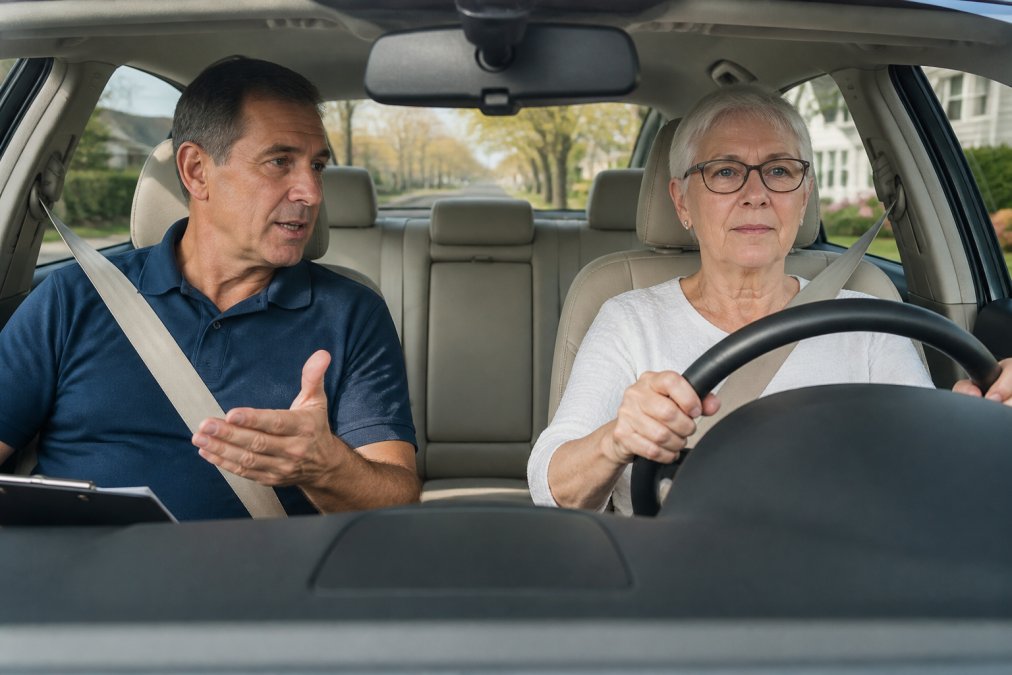
Why Anxiety, Not Ability, Ends Most Senior Driving Careers
Among older drivers, skill declines far more slowly than confidence. A competent driver starts avoiding the busy left turn, then the highway, then night driving, then unfamiliar routes. Each avoidance is rational in the moment and corrosive over time; within a year or two the driver is comfortable only on a few familiar roads, and the family starts talking about giving up the keys.
The fix is not reassurance, telling a nervous driver “you’re fine” does nothing, because they already know the fear is disproportionate. What works is structured exposure: driving situations ordered from least to most anxiety-provoking, each repeated until it stops producing a stress response before moving on.
The Exposure Ladder, Step by Step
A senior-friendly instructor builds an exposure ladder with the student, not for the student. The order below is a common starting point; the right sequence depends on what triggers the anxiety.
- Empty parking lot or quiet cul-de-sac. Vehicle control, smooth braking, mirror checks. No traffic, no time pressure.
- Low-speed residential streets at mid-morning. Real intersections, but light traffic and predictable sightlines.
- Familiar errand routes. The grocery store, the pharmacy, the doctor’s office. Purpose gives the drive a destination and a natural stopping point.
- Moderate arterials with protected left turns. This is where most senior anxiety lives, so it gets its own rung on the ladder.
- Highway on-ramps at off-peak hours. Merging is the skill; the highway itself is usually easier than the merge.
- Highway driving at speed, short segments first. One exit, then two, then a full commute-length drive.
- Night driving, then rain, then both. These are last because they stack two stressors at once.
Repeat each rung until the driver calls the situation “boring” rather than “manageable.” Boring is the signal to move up; manageable is not.
In-Car Techniques That Actually Reduce Anxiety
Instructors trained for older drivers use a few techniques that work in the moment:
- Narration. The driver says out loud what they see and what they plan to do. This occupies the part of the brain that would otherwise be running worst-case scenarios.
- Box breathing. Four counts in, four held, four out, four held. Done at red lights, not while moving. It lowers heart rate without distracting from the road.
- The three-second rule, spoken. Following distance is the single most controllable anxiety reducer, because it removes the pressure of the car ahead.
- Pre-planned routes. Before a drive, the instructor and student agree on the route and the turns. Surprise is the enemy of calm.
- Permission to pull over. Knowing they can stop at any safe spot without being judged removes the trapped feeling that drives panic.
A common mistake is pushing a nervous driver onto a highway too early. It usually backfires, and the setback can take weeks to undo. Patience here is strategy, not softness.
What Family Members Should and Should Not Do
Family involvement can accelerate progress or destroy it, depending on whether the family member rides along as a coach or a critic.
What helps:
- Let the instructor set the pace. Second-guessing the lesson plan in front of the driver undermines both of them.
- Ask the driver what felt hard, not what went wrong. The first question invites reflection; the second invites defensiveness.
- Celebrate the boring drives. A trip to the pharmacy that produced no drama is the actual win.
- Be patient with the timeline. Rebuilding confidence after a fender bender or a long break typically takes several weeks, not one lesson.
What backfires:
- Surprise “test drives” to see if the driver is ready. These spike anxiety and often produce a worse performance than the driver is actually capable of.
- Bringing up the license question after every mistake. It turns every drive into a referendum on independence.
- Comparing the driver to a younger version of themselves. The comparison is accurate and useless.
When Anxiety Is a Symptom, Not the Problem
Driving anxiety in older adults is common and treatable. It often shows up as avoidance: skipping the left turn, refusing the highway, driving only familiar routes. Avoidance shrinks a driver’s world one road at a time.
But anxiety is sometimes a symptom of something else. If a previously confident driver becomes anxious specifically about getting lost or about routes they used to handle easily, that points toward a cognitive issue. If anxiety appeared suddenly after a medical event, medication change, or fall, call a physician first, not a driving school.
Cognitive screening is separate from anxiety. If a family notices confusion, missed exits, or getting lost on familiar routes, a medical evaluation is the first step, not more lessons. A driving instructor can assess driving, not diagnose a cognitive condition.
Medical Clearance, DMV Reporting, and Vehicle Adaptations
Medical clearance and DMV reporting sit at the intersection of health and licensing, and both affect whether a senior driver keeps a valid license. Most guides skip this part, and it is where families most often get the specific rules wrong.
How Medical Reporting Actually Works
New York does not require every older driver to submit a medical form at renewal, but certain conditions and functional impairments must be reported, and drivers must meet minimum vision standards. Reporting can be triggered three ways:
- Self-report. A driver who knows they have a reportable condition is expected to disclose it. In practice, this is the least common path.
- Physician report. A physician who diagnoses a condition that affects driving ability is required to report it to the DMV. This is the path most families encounter, often without warning.
- Family or third-party report. Anyone can submit a concern to the DMV about a driver’s fitness. The DMV reviews the report and decides whether to request further evaluation.
Once a report is received, the DMV may request a vision test, medical exam, road test, or a combination. The license is not automatically suspended; it enters a review process. Many drivers come through with their license intact, sometimes with restrictions such as daylight-only driving or a corrective-lens notation.
New York DMV vision requirements for drivers outlines the minimum standards, and an eye exam is often the simplest part of the process. A common mistake is waiting until renewal to address a vision change. Addressing it early, with a current eyeglass or contact lens prescription, usually produces a smoother review than a last-minute scramble.
What Families Should Know Before Filing a Report
Reporting a parent or spouse to the DMV is one of the hardest calls a family makes. Understand what the process does and does not do before filing.
What it does:
- Triggers a formal review rather than an immediate revocation.
- Produces a documented outcome the family can point to, which often defuses the “you’re just picking on me” dynamic.
- Creates a path back to driving if the driver passes the required evaluations.
What it does not do:
- Guarantee the license is pulled. Drivers who pass the review keep driving.
- Replace a medical evaluation. The DMV review is about licensing, not diagnosis.
- Happen anonymously in every case. The driver may learn who filed the report.
Families often file a report as a last resort after months of informal pressure fails. In many cases, a structured driving evaluation with a certified instructor produces the same information earlier and with less conflict, because the recommendation comes from a neutral professional.
Vehicle Adaptations and Who Prescribes Them
Vehicle adaptations extend driving life when physical changes make a standard car difficult to operate. The key word is “prescribed”: adaptations are matched to a specific limitation by a driver rehabilitation specialist, usually an occupational therapist with additional driving training.
Common adaptations and the limitations they address:
- Hand controls for drivers with limited leg strength, range of motion, or lower-limb amputation. Push-pull or radial systems, depending on the driver’s grip and arm strength.
- Steering wheel knobs or spinner knobs for one-handed steering, common after a stroke or with arthritis in the dominant hand.
- Left-foot accelerator pedals for drivers who have lost use of the right leg but retain the left.
- Pedal extensions for drivers who need the controls closer due to shorter stature or limited hip flexion.
- Seat cushions, back supports, and swivel seats to improve posture, reach, and entry/exit.
- Wide-angle or convex mirrors to reduce blind spots when neck rotation is limited.
- Turn-signal and wiper extensions for drivers with limited fine motor control.
A driver rehabilitation specialist evaluates the driver in the vehicle, recommends specific equipment, and often supervises the first few drives with the new setup. The evaluation is typically done in a vehicle equipped with the adaptation, so the driver can feel the difference before committing.
Installation, Licensing, and Insurance
Three practical points families miss:
- Installation matters. Hand controls and other structural adaptations must be installed by a licensed installer. A homemade or improperly mounted system is a safety hazard and can void insurance coverage.
- The license may need a notation. Some adaptations require a restriction on the driver’s license, meaning the driver is only licensed to operate a vehicle with that equipment. Driving a car without it can be treated as driving out of class.
- Insurance should be notified. Most insurers cover adaptive equipment as part of the vehicle, but only if they know it is there. A quick call to the agent before installation avoids a claim dispute later.
Costs vary widely by adaptation and installer, and some equipment may be partially covered by vocational rehabilitation or certain insurance plans when tied to a documented medical need. The driver rehabilitation specialist who performs the evaluation is the right person to ask about coverage.
The Cost of Adult Driving Lessons and What Affects It
The cost of adult driving lessons depends on lesson length, package size, whether a road test is included, and whether the instructor travels to you. Treat any single quoted number with suspicion until you know what it covers.
Factors that move the price up or down:
- Number of lessons bundled into a package
- Lesson duration, typically 45 to 90 minutes
- Pickup and drop-off, which some schools charge extra for
- Road test support, including use of the instructional vehicle on test day
- Specialized instruction for anxiety, medical conditions, or adaptations
The cheapest per-lesson rate is rarely the cheapest overall. A student who needs eight lessons at a low rate pays more than one who needs four at a higher rate, and the second student is usually ready sooner.
Because pricing depends on your situation, ask for a current quote based on your goals. White Plains Driving Center can walk you through package options and what each includes before you commit.
Road Test Preparation and the 5-Hour Pre-Licensing Course
Road test preparation and the 5-hour pre-licensing course are two different requirements that often get confused. The pre-licensing course is a classroom requirement for new drivers; road test preparation is the behind-the-wheel practice that readies a driver for the examiner.
The 5-hour pre-licensing course is required before a new driver can schedule a road test in New York. New York DMV pre-licensing course requirement confirms the requirement and how the completion certificate works. Seniors applying for a first license still need it, even if they have driven for decades in another country.
Road test preparation focuses on what the examiner scores: observation habits, signaling, speed control, parking, and smooth intersection handling. General lessons build skill; test preparation builds the specific habits that earn a passing score.
A common mistake is treating the road test as a formality after years of driving. Longtime drivers lose points on habits the examiner watches closely, such as full stops and mirror checks, because they stopped doing them years ago.
Learning to drive again, or for the first time later in life, asks for patience and the right instructor more than courage. White Plains Driving Center has guided Westchester drivers through that process since 1978, with DMV-certified instructors, flexible scheduling, and calm instruction for nervous and returning drivers alike. Our packages include pre-licensing classes and road test support, so every step from first lesson to license is covered by one team. Get started with White Plains Driving Center and build the confidence to stay safely on the road for years to come.
Frequently Asked Questions
Are there specialized driving assessments for seniors in Westchester?
Yes. A proper senior driving assessment goes beyond a standard lesson. It typically includes a review of vision testing results, a cognitive screening if recommended, and an in-car driving evaluation covering vehicle control, parking techniques, and intersection safety. White Plains Driving Center offers skills assessments that identify specific areas for improvement before you commit to a full refresher course.
How much do driving lessons for seniors cost in Westchester?
The cost of adult driving lessons depends on the number of sessions, whether you need a 5-hour pre-licensing course, and if road test support is included. White Plains Driving Center does not publish fixed pricing because packages are built around each driver’s needs. Contact the school directly for a current quote and to compare package options before booking.
Do driving lessons help with insurance discounts for seniors?
Completing a defensive driving course approved by the New York State DMV can qualify you for an insurance reduction and may remove points from your driving record. Not every senior refresher course carries that approval, so ask whether the program is DMV-certified for insurance purposes before you enroll. White Plains Driving Center can confirm which of its courses meet the requirement.
How do I help an aging family member improve their driving skills?
Start with a conversation, not a confrontation. A neutral third party, such as a DMV-certified instructor, can conduct a driving evaluation and give objective feedback that family members often cannot. Caregiver resources in Westchester include the local motor vehicle bureau and area agencies on aging, which can point you toward senior driver safety programs and refresher lessons tailored to older adults.