Table of Contents
- How to Overcome Driving Anxiety as an Adult: Start With These 10 Techniques
- Technique 1: Deep Breathing and Grounding Techniques in the Car
- Technique 2: Progressive Muscle Relaxation to Calm Physical Symptoms
- Technique 3: Mental Rehearsal and Visualization Before You Drive
- Technique 4: Highway Merging Tips for Beginners
- Technique 5: Gradual Exposure and Starting Small
- Technique 6: Planning Your Journey and Using an Exit Strategy
- Technique 7: Managing Physical Symptoms of Anxiety Behind the Wheel
- Technique 8: Visualization Under Real Conditions
- Technique 9: The Importance of a Passenger or Companion
- Technique 10: Post-Drive Debriefing
- Frequently Asked Questions
Last Updated: September 12, 2026
How to Overcome Driving Anxiety as an Adult: Start With These 10 Techniques
Driving anxiety is a stress response that turns routine highway driving into physical and mental symptoms, from a racing heart to a white-knuckle grip on the wheel. At White Plains Driving Center, we’ve worked with nervous drivers since 1978, and the pattern is consistent: fear of highways rarely comes from bad driving skill. It comes from feeling unprepared for speed, merging, and traffic flow all at once. That’s why the techniques below focus on preparation and control, not just “calming down”, including the specific maneuvers most guides skip.
Why Highways Trigger Anxiety
Highways trigger anxiety because they combine high speeds, merging traffic, and limited exit options, leaving little room for hesitation. A nervous driver’s body reads this as threat: heart rate climbs, hands tighten, and visual scanning narrows. The fix isn’t avoiding highways forever, it’s building skills and calm in small, repeatable steps.
Technique 1: Deep Breathing and Grounding Techniques in the Car
Deep breathing directly lowers physiological arousal before it hijacks your hands and eyes. Before you turn the key: inhale through your nose for four counts, hold for four, exhale for six. Repeat five times.
Grounding works the same way once you’re moving. Name three things you can see, two you can hear, and one you can feel through the seat and wheel, pulling attention back to the present instead of the “what if” spiral.
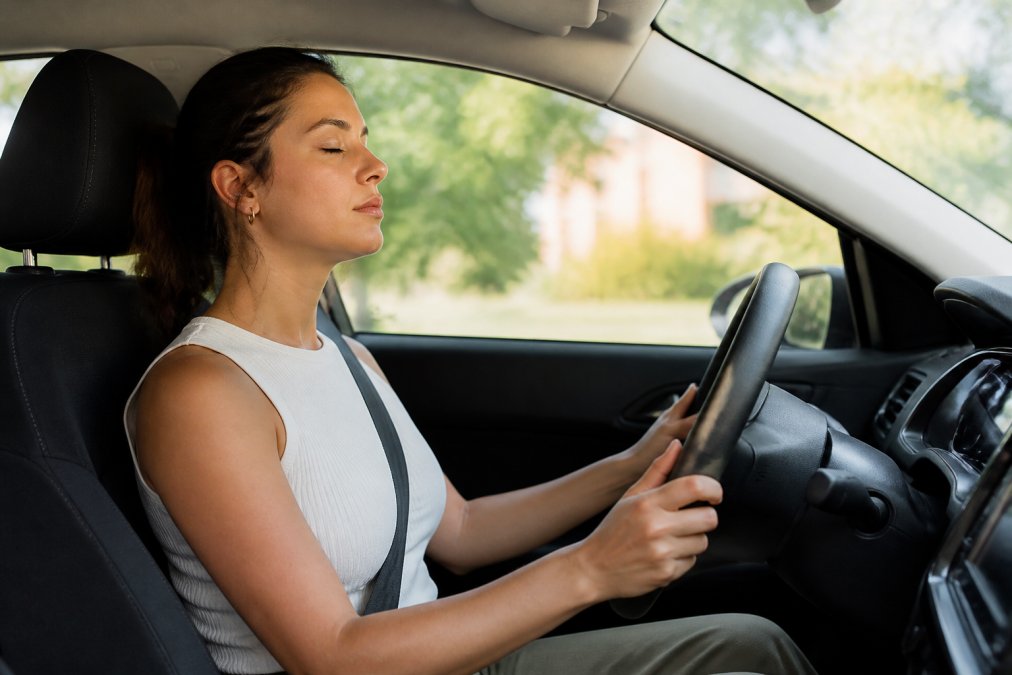
Set your breathing pattern before you merge, not during. Practicing at a stoplight or in your driveway builds the habit so it’s automatic when traffic speeds up.
Apps like Calm offer guided breathing and mindfulness sessions you can run before a drive, which helps if you want structure rather than counting in your head.
Technique 2: Progressive Muscle Relaxation to Calm Physical Symptoms
Progressive muscle relaxation (PMR) means tensing and releasing muscle groups one at a time to reduce tension behind the wheel. Start with your hands: squeeze the wheel lightly for five seconds, then release. Move to your shoulders, then your jaw.
Most nervous drivers don’t notice they’re gripping the wheel or clenching their jaw until their hands ache. PMR teaches you to catch that tension early, before it feeds the anxiety loop.
Technique 3: Mental Rehearsal and Visualization Before You Drive
Mental rehearsal means walking through your entire route in your head before you drive it, including every merge, lane change, and exit. It’s a structured preview that reduces the surprise factor that spikes anxiety.
Spend five minutes before a trip picturing yourself signaling, checking blind spots, and matching highway speed smoothly. Drivers who rehearse mentally execute with far less hesitation in real traffic.
Technique 4: Highway Merging Tips for Beginners
The safest merge matches the speed of traffic flow before you enter the highway, not after. Most merging anxiety comes from entering too slowly and then trying to accelerate into a gap that’s already closing. The fix is technical: read the ramp, the acceleration lane, and the traffic pattern before you commit.
Read the Ramp Before You Reach It
On-ramps fall into two broad shapes, and each demands a different plan:
- Cloverleaf and loop ramps curve sharply and often end in a short acceleration lane. You need to build speed through the curve, not after it, because you may have only a few hundred feet to match highway traffic.
- Straight or tapered ramps give you a longer runway. Use the full length to build speed and scan for a gap rather than creeping to the merge point and then accelerating.
Nervous drivers often treat the ramp as a place to slow down and think. That instinct is backwards, the ramp is where you do your thinking at speed so the merge itself is almost automatic.
Step-by-Step Merge Protocol
- Scan the highway from the ramp, not the merge point. Look over your left shoulder and through your mirrors as soon as the highway comes into view. You want to know the traffic pattern before you’re committed.
- Build speed on the on-ramp to match highway speed, not below it. If traffic is moving at highway speed, your speedometer should read close to that before the acceleration lane ends.
- Signal early, well before the merge lane ends. Signaling early lets drivers already on the highway read your intent and either open a gap or hold their lane.
- Pick your gap before you reach it, then commit smoothly. Identify a specific space between two vehicles and aim for it. Do not drift toward the merge point hoping a gap appears.
- Adjust speed to the gap, not the other way around. If the gap is slightly ahead, ease off; if it’s slightly behind, maintain speed and let it come to you.
- Settle into lane discipline once you’re in. Pick a lane, hold a steady speed, and re-establish your following distance before you do anything else.
The Zipper Merge, Explained
When two lanes merge into one, common at construction zones and some on-ramps, use the zipper merge: both lanes until the merge point, then alternate one vehicle at a time. Many nervous drivers merge early to “be polite,” which creates a longer, more unpredictable backup. Merging late and alternating is safer and, in most states, the officially recommended pattern.
The most common merge mistake is slowing down at the end of the on-ramp. That forces highway traffic to brake around you and creates the exact situation nervous drivers fear most. If you find yourself at the end of the ramp going too slow, the safest recovery is to continue onto the shoulder, come to a full stop, and wait for a clear gap, not to force your way in at low speed.
Practicing the Merge Without Traffic
Rehearse the physical sequence, scan, signal, match speed, commit, on any empty on-ramp during low-traffic hours. Drive the ramp, merge, take the next exit, and loop back. Ten repetitions teach your body the sequence faster than reading about it.
Technique 5: Gradual Exposure and Starting Small
Exposure therapy proves to your nervous system, in small doses, that highway driving is survivable. Start on a quiet stretch during low-traffic hours, drive one exit, and get off. Repeat until routine, then extend the distance. Mastering these brief intervals of exposure relies on consistent nervous system regulation to keep your physical response to the road within a manageable range.
Confidence is cumulative: master one exit this week, handle three next week. Skipping straight to rush-hour traffic usually backfires and reinforces the fear.
Technique 6: Planning Your Journey and Using an Exit Strategy
An exit strategy is a pre-planned answer to “what do I do if I start to panic?” Knowing your next exit, rest stop, or shoulder options before you leave removes the trapped feeling that fuels highway panic attacks.
Before every drive, note your exits, pull-over options, and a backup route. If anxiety spikes, you already know where you’re getting off, and that preparation changes how the whole drive feels.
Technique 7: Managing Physical Symptoms of Anxiety Behind the Wheel
Managing physical symptoms starts with recognizing them early: shallow breathing, tight grip, tense shoulders, narrowed visual scanning. Catch two and you can intervene before a full panic response builds. But recognition alone isn’t enough, here are the concrete, non-distracting adjustments that actually change how your body feels behind the wheel.
Sensory and Equipment Adjustments That Lower Arousal
- Climate control. Anxiety raises body temperature and makes skin feel flushed. Set the cabin a few degrees cooler than feels neutral and aim a vent at your face or wrists. Cool air on the skin is one of the fastest ways to interrupt a rising panic response.
- Seat position. A seat reclined too far forces you to reach for the wheel, which tightens your shoulders. Sit upright enough that your wrists rest on top of the wheel with a slight bend in your elbows, and keep your back supported.
- Steering grip. Switch from a death grip to a relaxed hold at roughly 9 and 3 o’clock. Squeezing the wheel restricts blood flow and feeds the tension loop.
- Audio. Calming audio works best when it’s predictable. A familiar playlist, a low-key podcast, or a guided breathing track removes the cognitive load of choosing what to listen to. Avoid anything that spikes your heart rate, loud music, tense talk radio, or sudden alerts.
- Sunglasses. Bright glare and squinting both increase physical tension. Polarized sunglasses reduce glare and, as a side benefit, give you a small sense of separation from other drivers’ eye contact.
- Chewing gum or a hard candy. The repetitive jaw motion mimics the relaxation response and gives your mouth something to do other than clench.
None of these are cures, they’re small physical inputs that, stacked together, keep your baseline arousal low enough for a breathing technique to land.
Emergency Pull-Over Protocol
If symptoms escalate past the point where you can drive safely, do not try to “push through” a panic attack at highway speed. Pulling over is a skill, not a failure. Here is the sequence:
- Signal early and to the right. Give drivers behind you time to read your intent.
- Check mirrors and blind spot. Confirm the right lane and shoulder are clear.
- Ease off the accelerator gradually. Do not brake hard, sudden braking at highway speed is itself a hazard.
- Move to the right shoulder or, better, the next exit. An exit ramp or parking lot is always safer than a shoulder if one is within reach.
- Stop fully, set the parking brake, and turn on your hazard lights. Keep your seatbelt on.
- Stay in the vehicle unless it is unsafe to do so. If you must exit, use the passenger side and stand well away from traffic.
- Do your breathing or grounding exercise only after the car is fully stopped. Trying to run a breathing pattern while merging or changing lanes splits your attention in exactly the wrong way.
Once you’re stopped and calm, decide whether to continue or reroute. There’s no rule that says you must finish the drive. Getting off safely and resuming when ready is a legitimate outcome that builds evidence you can handle a spike without losing control.
Practice the pull-over sequence once on a quiet stretch of highway when you are not anxious. Knowing your body has done it before removes one layer of panic from the real moment.
When Symptoms Are Medical, Not Just Anxious
Some symptoms behind the wheel, chest pain, numbness in an arm, sudden vision changes, or a racing heart that doesn’t settle after you stop, can signal a medical issue rather than anxiety. If symptoms are new, severe, or don’t resolve within a few minutes of pulling over, treat them as a medical emergency and call for help. Anxiety and cardiac symptoms can feel similar; it’s always safer to be evaluated than to assume.
Technique 8: Visualization Under Real Conditions
Visualization doesn’t stop once you’re on the road. Narrate your driving out loud or in your head: “I’m checking my mirror, I’m matching speed, I’m picking my gap.” This keeps situational awareness active instead of drifting into worst-case scenarios.
Technique 9: The Importance of a Passenger or Companion
A calm passenger can talk you through a merge or keep the conversation steady, lowering physiological arousal without effort. Choose someone who stays quiet during tricky maneuvers and reassuring afterward, not someone who gasps or grabs the door handle.
Technique 10: Post-Drive Debriefing
Post-drive debriefing is a two-minute review after each trip: what felt smooth, what felt tense, and what you’d do differently next time.
This is the step almost every guide skips, and it turns a single good drive into lasting confidence. Over a few weeks, your notes show real progress, powerful evidence against the belief that you “can’t do highways.”
| Technique | Best For | Time to Practice |
|---|---|---|
| Deep breathing and grounding | Pre-drive nerves | 2-3 minutes |
| Progressive muscle relaxation | Physical tension | 5 minutes |
| Mental rehearsal | Route anxiety | 5 minutes |
| Merge protocol | Merging traffic | Per merge |
| Gradual exposure | Building confidence | Weekly |
| Exit strategy planning | Panic prevention | 5 minutes |
| Symptom management | Mid-drive anxiety | As needed |
| Real-condition visualization | Situational awareness | During drive |
| Passenger support | Extra reassurance | Per drive |
| Post-drive debriefing | Long-term progress | 2 minutes |
The techniques that move the needle fastest are the ones practiced before and after the drive, not during it. Preparation and review beat willpower every time.
If self-practice isn’t enough, structured instruction helps. The AAA Foundation for Traffic Safety research on driver confidence shows that guided, low-pressure practice builds safer habits than solo trial and error, and the NHTSA’s defensive driving guidance covers the following distance and speed management basics that underpin every technique above. For drivers who want a structured, patient approach, the New York DMV’s licensing resources outline the official requirements, while White Plains Driving Center’s DMV-certified instructors build lessons around your specific triggers, at your pace.
Frequently Asked Questions
How to get rid of highway driving anxiety?
Overcoming highway driving anxiety typically involves a combination of relaxation techniques, gradual exposure, and skill-building. Start with deep breathing and grounding exercises to manage immediate stress. Practice on quieter roads before moving to highways, and use mental rehearsal to prepare for specific maneuvers like merging. Professional driving lessons for nervous adults can provide structured, supervised practice. With consistent effort, most drivers see significant improvement in confidence within weeks.
What are some tips for nervous drivers to manage driving anxiety?
Nervous drivers can manage anxiety by using deep breathing, progressive muscle relaxation, and grounding techniques before and during drives. Plan your route in advance, avoid peak traffic times, and take breaks if needed. Practice defensive driving with visual scanning and maintain a safe following distance. Bringing a calm passenger can also help. Remember that anxiety is common and manageable with practice and patience.
How to get more confident driving on the highway?
Confidence on the highway builds through gradual exposure and skill mastery. Start with short drives during low-traffic hours, then gradually increase distance and complexity. Focus on specific skills like merging, lane discipline, and speed management. Mental rehearsal and post-drive debriefing help reinforce positive experiences. Enrolling in professional driving lessons for nervous adults can accelerate progress with expert guidance and feedback.
How to get over fear of merging on highway?
To overcome merging fear, practice the step-by-step merge protocol: use the on-ramp to match highway speed, check mirrors and blind spots, signal, and merge smoothly. Start on quieter highways with lighter traffic. Visualize the maneuver beforehand and use deep breathing to stay calm. Repeated practice with a supportive passenger or instructor builds confidence. Remember that most drivers are also focused on their own driving, not judging yours.
Is it normal to be scared of highway driving?
Yes, it is very common to feel scared of highway driving, especially for new or returning drivers. High speeds, merging traffic, and multiple lanes can feel overwhelming. This anxiety is a normal response to a challenging situation. Many drivers overcome it with time, practice, and techniques like deep breathing, mental rehearsal, and gradual exposure. Professional instruction can also help if anxiety persists.
Highway anxiety responds to preparation, not avoidance. The drivers who improve fastest are the ones who plan their route, practice one technique at a time, and debrief after every drive. White Plains Driving Center has helped nervous drivers build that confidence since 1978, with DMV-certified instructors, flexible scheduling, and packages that include road test support. Get started with White Plains Driving Center and turn highway driving from a source of dread into a routine skill.