Table of Contents
- What to Expect From Driving Lessons in New Rochelle
- Behind-the-Wheel Training and Road Test Preparation
- How Many Driving Lessons You Need to Pass Your Road Test
- Cost of Driving Lessons in New York
- Best Driving Schools for Nervous Drivers
- Pre-Licensing Courses and DMY Requirements
- Getting Started With Your First Lesson
- Frequently Asked Questions
Last Updated: October 3, 2026
What to Expect From Driving Lessons in New Rochelle
Professional driving lessons new rochelle build the foundation for safe, confident driving. At White Plains Driving Center, we’ve worked with thousands of students since 1978 and learned what separates genuinely prepared drivers from those who simply memorize test routes.
Professional driving instructors watch for patterns, grip, intersection scanning, anticipation, that matter far more than GPS navigation. Our DMV-certified instructors build muscle memory and decision-making skills, not just test-passing techniques.
Nervous drivers often expect judgment but find patience instead. A good instructor explains the “why” behind each maneuver, building confidence through clear communication.
Schedule your first lesson during a quieter time of day, early morning or mid-afternoon, rather than rush hour. You’ll have fewer distractions while you’re building foundational skills, and you’ll progress faster with less sensory overload.
Behind-the-Wheel Training and Road Test Preparation
Behind-the-wheel training develops judgment to handle any driving situation safely, not memorizing specific routes.
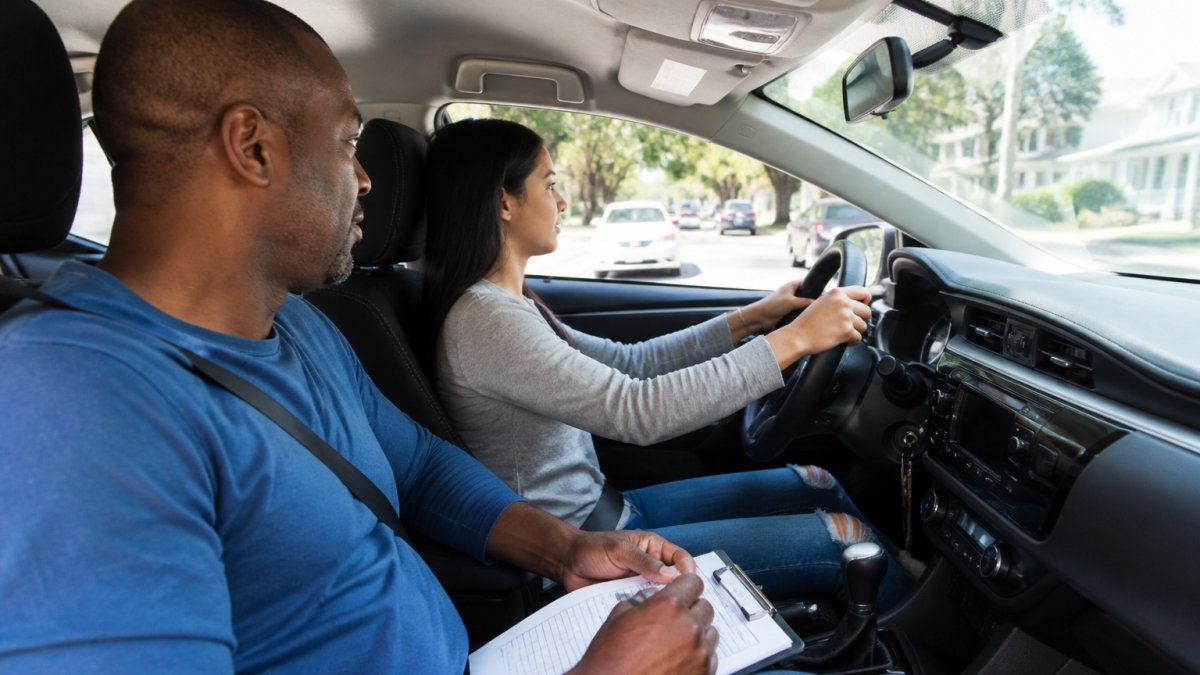
Road test examiners assess smooth acceleration, braking, mirror checks, signaling, and hazard response. Our instructors understand examiner expectations and prepare you to drive safely in real conditions, not just pass.
Behind-the-wheel training covers highway driving, neighborhood navigation, parallel parking, and defensive techniques. Defensive driving, anticipating other drivers’ moves, helps nervous drivers realize they control only their own preparation, shifting anxiety from paralyzing to manageable.
Road test examiners aren’t trying to trick you. They’re assessing whether you can operate a vehicle safely in normal conditions. Focus on smooth, predictable movements and clear communication through your driving choices, signals, mirror checks, appropriate speed.
How Many Driving Lessons You Need to Pass Your Road Test
The number of lessons needed depends on your starting point, practice frequency, and confidence development. Clear patterns exist, though no magic number applies universally.
A typical beginner needs 10-20 hours of professional instruction before road-test readiness, assuming consistent practice between lessons with a licensed driver. Regular practice between lessons accelerates progress significantly.
International drivers adapting to U.S. traffic patterns need additional lessons to retrain muscle memory and learn American road rules. This is normal and expected.
Nervous drivers benefit from understanding that anxiety signals responsibility, not unpreparedness. Focused lessons on anxiety-triggering situations help significantly.
The key question is “when do I feel genuinely ready?” If you’re second-guessing decisions or panicking in normal traffic, you need more practice. Smooth execution and forward thinking indicate readiness.
Cost of Driving Lessons in New York
Pricing varies by instructor experience, lesson length, package structure, and bundled services. Understanding the breakdown helps you budget and compare schools fairly.
Typical Pricing Structure
Most driving schools in Westchester County charge between $60 and $150 per hour for behind-the-wheel instruction, with variation based on instructor credentials and demand. A standard lesson package typically includes:
- Single lessons: $70-$120 per 1-hour session
- 5-hour packages: $350-$600 (roughly $70-$120 per hour with modest bulk discount)
- 10-hour packages: $650-$1,100 (5-10% savings vs. single lessons)
- 5-hour pre-licensing classroom course: $50-$150 (online or in-person)
- Road test preparation packages: $200-$400 for 3-5 focused sessions
International drivers typically budget 15-25 hours of instruction, totaling $1,000-$3,000 before taxes and fees.
What Affects Your Total Cost
Cost factors include instructor experience, lesson frequency, and package discounts.
Insurance and Long-Term Savings
A certified defensive driving course can reduce auto insurance premiums. Ask your insurer about discounts before enrolling.
Budget for road test fees, license application, permit renewal if needed, and potential rescheduling fees.
How to Compare School Pricing Fairly
Request written pricing that clarifies what’s included (5-hour course, road test prep, rescheduling fees). Ask for a total estimate for your specific situation rather than generic rates.
If budget is tight, consider spacing lessons over 3-4 months and practicing intensively between sessions with a licensed driver. This extends your timeline but reduces weekly out-of-pocket costs and often improves retention because you’re practicing more frequently.
Best Driving Schools for Nervous Drivers
The best schools for nervous drivers focus on building confidence through calm instruction and gradual exposure to challenging situations.
White Plains Driving Center specializes in nervous drivers, starting with quiet streets and gradually introducing complex traffic. Our instructors explain what to expect, avoid criticism, and don’t rush mastery.
A quality school matches you with an instructor whose communication style complements your learning needs. Patience and clear explanation work better than pressure.
The best schools offer flexibility and work with nervous drivers rather than penalizing rescheduling.
Pre-Licensing Courses and DMY Requirements
Understanding New York’s licensing pathway prevents costly delays. Here are the official steps for Westchester County residents.
The New York State Licensing Roadmap for First-Time Drivers
The process has five distinct phases. Skipping or delaying any step can push back your road test date by weeks.
Phase 1: Obtain Your Learner Permit (MV-44 Application)
Before you take a single driving lesson, you must pass the written knowledge test and obtain a learner permit.
- Visit your local DMV office or apply online at New York State DMV online services.
- Bring proof of identity (passport, birth certificate, or state ID), proof of Social Security number, and proof of residency (utility bill, lease, or bank statement dated within 30 days).
- Pay the application fee (non-refundable).
- Pass the written knowledge test (50 questions; 40 correct answers required). The test covers traffic laws, road signs, and safe driving practices outlined in the New York State Driver’s Manual.
- Receive your learner permit, valid for 6 months. If you don’t pass your road test within 6 months, you’ll need to renew it.
Phase 2: Complete the 5-Hour Pre-Licensing Course (Required for Drivers Under 18)
All first-time applicants under 18 must complete a 5-hour classroom course before scheduling a road test. This is non-negotiable.
- Enroll in a DMV-approved 5-hour course offered by a licensed driving school. Courses are available online or in-person.
- Online courses can be done on your own schedule.
- In-person classroom courses are usually offered on weekends or after school and take one full day (8 a.m.-1 p.m. or similar).
- Upon completion, you’ll receive a certificate of completion (MV-278). Keep this; you’ll need it when you schedule your road test.
Note for Adult Drivers (Age 18+): If you’re 18 or older and applying for your first license, you do not need the 5-hour course.
Phase 3: Complete Behind-the-Wheel Training (Highly Recommended; Often Required by Insurance)
- Enroll in a driving school and schedule lessons. Most students need instruction before they’re road-test ready.
- Lessons typically last 1 hour.
- Between lessons, practice with a licensed driver (parent, guardian, or adult family member) in your learner permit.
- Your instructor will assess when you’re ready for a road test, typically after demonstrating competence in highway driving, parking, and defensive techniques.
- Timeline: This phase usually takes 2-4 months, depending on lesson frequency and practice between sessions.
Phase 4: Schedule and Pass Your Road Test
Once you’ve completed the 5-hour course (if required) and feel ready, schedule your road test through the DMV.
- Visit New York State DMV road test scheduling or call your local DMV office to book an appointment.
- Bring your learner permit, proof of identity, proof of residency, and your 5-hour course certificate (if applicable).
- Pay the road test fee (non-refundable if you don’t pass).
- Road test appointments in Westchester County are available depending on demand. Book early.
Where Road Tests Are Administered in Westchester County
The DMV operates testing sites in several locations. Your road test will be conducted at one of these facilities:
- New Rochelle DMV office: 100 Mamaroneck Avenue, New Rochelle, NY 10801. If you’re taking driving lessons new rochelle, tests are administered on weekdays and some Saturdays.
- White Plains DMV office: 44 South Drive, White Plains, NY 10601. This is the busiest Westchester location; appointments book 6-8 weeks in advance.
- Yonkers DMV office: 87 South Drive, Yonkers, NY 10701.
Each location uses similar road test routes in their immediate area.
The Road Test Itself
The test includes:
- Basic vehicle controls (starting, steering, acceleration, braking)
- Lane changes and turns
- Parking (parallel, perpendicular, or angle parking depending on the route)
- Merging onto a highway or major road
- Responding to traffic signals and signs
- Defensive driving (anticipating hazards, maintaining safe following distance)
The examiner is assessing whether you can operate a vehicle safely in normal conditions. You must score to pass. Common reasons for failing include:
- Unsafe lane changes or turns
- Failure to yield or obey traffic signals
- Improper mirror checks or blind-spot awareness
- Excessive speed or inability to control the vehicle
- Parking errors (hitting the curb, taking more than three attempts)
Phase 5: Obtain Your Full Driver’s License
If you pass your road test, you’ll receive a temporary license on the spot. Your permanent license will arrive by mail within 2 weeks.
- Your license is valid for 5 years (until age 21 for first-time teen drivers; standard expiration for adults).
- If you fail, you can retake the test after 14 days. There’s no limit on attempts, but each attempt costs another fee.
Timeline Summary
From learner permit to full license typically takes time:
Book your test as soon as you feel ready; don’t wait until the last minute.
International Drivers and License Transfers
If you’re transferring a license from another state or country:
- You do not need the 5-hour pre-licensing course.
- You must still pass the written knowledge test and the road test.
- If your previous license is from a country that drives on the left (UK, Australia, India, etc.), you’ll need additional behind-the-wheel instruction to retrain your muscle memory for right-side driving. Budget for lessons.
- Bring your valid foreign or out-of-state license, proof of identity, and proof of residency to your DMV appointment.
The most critical step is scheduling your road test early. Once you’ve completed your 5-hour course and feel confident in your behind-the-wheel skills, book your test immediately rather than waiting.
Getting Started With Your First Lesson
Your first lesson sets the tone for your entire learning experience. Here’s what actually happens and how to prepare yourself mentally.
Your instructor will ask about your experience, anxiety triggers, and goals. Be honest, this helps them teach more effectively.
The first session starts in a quiet area with basic vehicle controls. Your instructor explains your actions and adjusts based on observation.
Most nervous drivers find the first lesson manageable and feel relief realizing the instructor won’t yell or judge.
Before your first lesson, bring your learner permit (required by law) and arrange transportation to the school.
Consistency matters: weekly lessons work better than sporadic ones. Practice between sessions with a licensed driver to build automatic skills.
Getting your license is a significant milestone, and you deserve instruction that respects both your safety and your confidence. White Plains Driving Center has been preparing drivers in Westchester since 1978, and we specialize in working with nervous beginners, adult learners, and international drivers who need patient, clear instruction. Our DMV-certified instructors focus on building genuine skill and confidence, not just getting you through the test. New York State Department of Motor Vehicles licensing requirements outlines the official steps you’ll need to complete.
Frequently Asked Questions
How much do driving lessons cost in New York?
The cost of driving lessons in New York varies based on lesson length, instructor experience, and whether you choose package deals or hourly rates. Pricing depends on the school’s location, whether they offer road test preparation, and any bundled services like pre-licensing courses. Contact White Plains Driving Center directly for current pricing and package options that fit your budget.
How many driving lessons do I need to pass my road test?
The number of hours of behind-the-wheel training needed before attempting a road test varies based on prior driving experience and comfort level. Nervous drivers or those new to U.S. traffic laws may need additional lessons. A DMV-certified instructor can assess your progress and recommend the number of lessons needed to build confidence and master the specific maneuvers examiners test.
What should I look for in a driving school for anxious drivers?
Choose a school with DMV-certified instructors trained to work with nervous drivers. Look for instructors who emphasize calm instruction, clear communication, and patience. Schools specializing in anxiety-prone students often customize lessons to address specific fears like highway driving or parallel parking. Read reviews from other nervous drivers, and ask about the instructor’s experience with anxious students before booking.
What is the difference between a pre-licensing course and behind-the-wheel training?
A 5-hour pre-licensing course is classroom instruction that covers New York traffic laws, road signs, and safe driving practices, it’s a state requirement before you can take your road test. Behind-the-wheel training is hands-on practice with an instructor in an actual vehicle, where you develop driving skills and learn maneuvers like parallel parking and highway merging. Both are essential for a complete driving education.