Table of Contents
- Why Intensive Driving Courses Fit a Full-Time Schedule
- Intensive Driving Course vs Weekly Lessons: Which Fits Your Week?
- Flexible Driving Lesson Scheduling Around Work and Family
- How Many Driving Lessons Do I Need to Pass in New York?
- Road Test Preparation for Adults Returning to Driving
- Course Formats, Providers, and Pricing Compared
- Choosing the Right Intensive Course for Your Situation
- Frequently Asked Questions
Last Updated: October 6, 2026
Why Intensive Driving Courses Fit a Full-Time Schedule
Intensive driving courses compress driver education into a short, concentrated window instead of spreading lessons across months. For busy professionals, that compression means faster learning, better retention between sessions, and test readiness without rearranging your calendar for half a year.
At White Plains Driving Center, we have taught Westchester drivers since 1978. Adults juggling work, kids, and commutes often find that fewer, longer, closely spaced sessions are more effective than one lesson every other Saturday.
There is a real learning-science reason for that. The AAA Foundation for Traffic Safety has long studied how novice drivers build skill, and the finding that matters here is simple: skills practiced close together stick better than skills practiced weeks apart.
The core advantage of an intensive driving course is not speed. It is continuity. Skills practiced within days of each other compound; skills practiced weeks apart decay.
Intensive Driving Course vs Weekly Lessons: Which Fits Your Week?
An intensive driving course suits learners with a deadline or a packed schedule; weekly lessons suit learners who need time to absorb, save, or recover between sessions.
| Factor | Intensive Course | Weekly Lessons |
|---|---|---|
| Typical duration | Days to a few weeks | Several months |
| Session spacing | Same day or consecutive days | Once or twice a week |
| Best for | Deadlines, tight schedules | Flexible timelines, tighter budgets |
| Skill retention | High, due to continuity | Depends on practice between lessons |
| Scheduling pressure | High (you block out time) | Low (fits around anything) |
| Cost rhythm | Paid in a package | Paid per lesson |
One caveat on cost rhythm: an intensive package looks like a bigger upfront number than a single weekly lesson, but what matters is total cost to reach test readiness, not cost per session.
When Weekly Lessons Still Make Sense
Weekly lessons remain the better choice in three situations: if your schedule cannot absorb several sessions in a short window, if you need to spread cost across months, or if you are an anxious beginner who benefits from processing time between sessions.
Flexible Driving Lesson Scheduling Around Work and Family
Flexible driving lesson scheduling is the biggest practical barrier for working adults, and where most schools quietly fail their students. A school that only offers weekday 10 a.m. slots is not serving professionals, whatever its website claims.
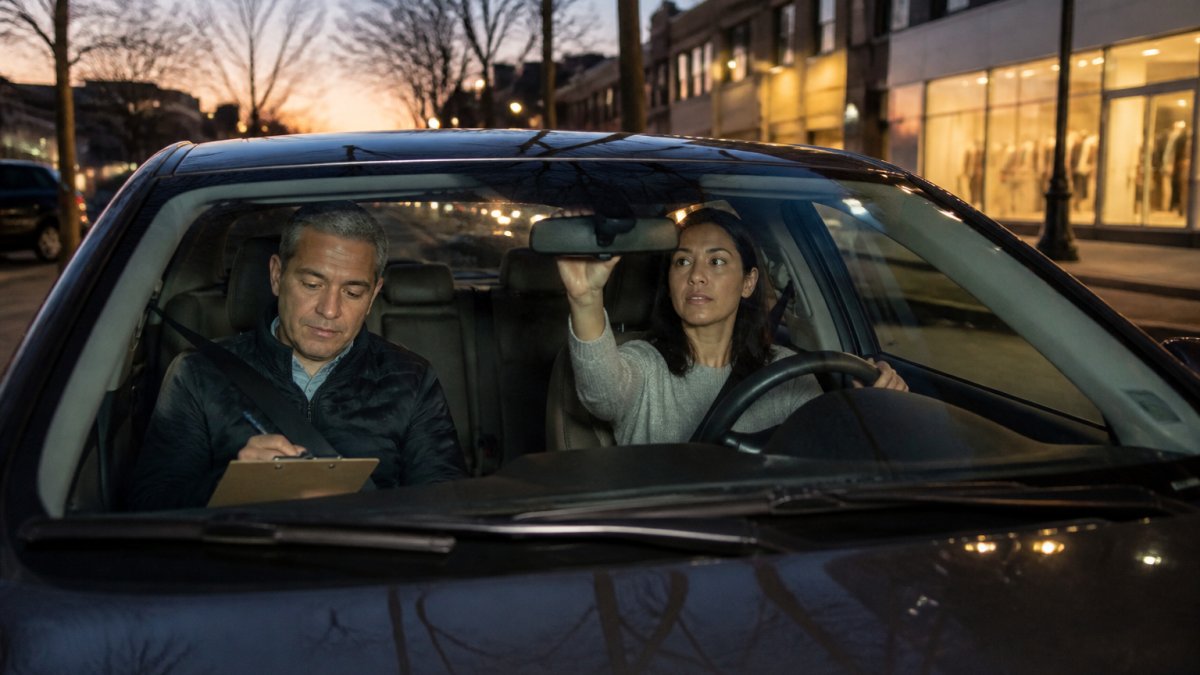
The workaround is to build your lesson plan around the hours you actually have, not the hours a school prefers to fill, treating your driving package like any other recurring commitment, with protected blocks and a fallback plan.
Evening, Weekend, and Early-Morning Options
- Do you offer lessons after 5 p.m. on weekdays?
- Are weekend slots available, and how far out are they booked?
- Can I hold a recurring slot, or do I rebook every time?
What a Work-Compatible Week Actually Looks Like
Most professionals cannot disappear for two weeks. The realistic pattern is a compressed block of longer sessions on days you already have, plus a shorter mid-week session:
| Template | Session Pattern | Total Weekly Seat Time | Best For |
|---|---|---|---|
| Weekend block | Two 2-hour sessions Saturday and Sunday | About 4 hours | Weekday travel, on-call roles, parents |
| Split week | One 2-hour evening session plus one 2-hour weekend session | About 4 hours | Hybrid and in-office schedules |
| Compressed sprint | Three 2-hour sessions across consecutive days off or PTO | About 6 hours | Hard deadlines, test already booked |
Two-hour sessions are the practical sweet spot for adults. Shorter sessions eat your commute to and from the lesson; much longer sessions produce fatigue that shows up as sloppy mirror checks and rushed stops. If a school only sells 45-minute lessons, you will spend more calendar days reaching the same seat time.
Handling Travel, Commuting, and Unpredictable Weeks
- Front-load the package. Book most sessions in the first half of your window. If a work trip lands in week two, you have already banked the foundation skills and can absorb a gap without starting over.
- Keep a recurring anchor slot. Even one protected weekly slot, say, Saturday at 9 a.m., preserves continuity when everything else moves. Rebooking from scratch every week is how learners lose two or three weeks without noticing.
- Use commute time as observation practice. You are already in the car. Narrating what other drivers do, spotting stale green lights, and predicting lane changes is free reinforcement between paid sessions.
If you commute by train or drive a route you know cold, tell your instructor. A good one will route lessons through the intersections, merges, and parking situations you actually face, so your seat time doubles as route familiarity.
If you can only drive on weekends, book your entire package of weekend slots at once rather than one at a time. Recurring slots protect you from losing your preferred time to other students.
Confirm the school’s cancellation policy before you pay. A same-day cancellation fee on a package you booked around a work trip can cost you both the session and the money.
How Many Driving Lessons Do I Need to Pass in New York?
There is no fixed number, and any school that quotes one before meeting you is guessing. Most adult learners need a package of lessons plus supervised practice, and the total depends on your starting point, comfort level, and outside practice.
New York State sets the floor, not the ceiling. Every new driver must complete the New York DMV pre-licensing course requirement, commonly called the 5-hour class, before scheduling a road test.
Beyond that requirement, lesson count scales with experience:
- Complete beginner: More lessons, spread across skill-building, parking, and road practice
- Returning adult driver: Fewer lessons, focused on refreshing habits and test-specific skills
- International driver adapting to U.S. rules: A middle range, heavy on local traffic patterns and DMV expectations
Skipping the 5-hour pre-licensing course will block your road test booking entirely, no matter how many lessons you have completed. Confirm the requirement with the DMV before you schedule.
Road Test Preparation for Adults Returning to Driving
Road test preparation for adults is different from preparation for teenagers, and most schools do not adjust. Adults carry years of observation, some bad habits, and often real anxiety. The preparation has to address all three.
What the Examiner Actually Scores
The road test scores specific, observable behaviors:
- Observation: Do you check mirrors and blind spots before moving?
- Control: Is your speed appropriate, your steering smooth, your braking gradual?
- Signaling: Do you signal early and consistently?
The most common failure point is often not a lack of skill but nerves causing a missed mirror check or an incomplete stop. Practice under mild pressure, with someone watching, can help close that gap.
If you have been driving for years but dread the test itself, tell your instructor directly. Test-specific coaching is a different job from teaching someone to drive, and it should be requested explicitly.
Course Formats, Providers, and Pricing Compared
Course formats fall into four broad categories: full intensive packages, segmented modular programs, private instructor marketplaces, and pay-per-lesson arrangements. Each suits a different learner, and pricing transparency varies wildly.
| Provider Type | Format | Pricing Model | Best For |
|---|---|---|---|
| White Plains Driving Center | Intensive packages with road test support | Contact for pricing | Westchester adults wanting DMV-certified, calm instruction |
| Drive Rite NY | Fast-track programs for professionals | Package-based, contact for pricing | Urban commuters needing fast-track licensing |
| 911 Driving School | Pace-controlled sessions | Per-session or package | Adults wanting flexible, confidence-focused pacing |
| Wheel to Drive | Segmented modules (Segment 1 and 2) | Flat fee, stated per segment | Students wanting a clear modular path |
| Superprof | Private instructor marketplace | Pay-per-lesson | Learners needing highly specific one-on-one scheduling |
Our instructors at White Plains Driving Center are DMV-certified and trained to work with nervous, adult, and international drivers, and every package includes road test support. We have been serving drivers since 1978, and one recent student put it simply: “He gave extremely clear instructions, was calm, cool, and collected throughout the process.
What “Total Cost to Test Readiness” Actually Includes
Sticker price is the least useful number here. What matters is everything you will pay between your first lesson and your road test. Build that figure from these line items:
- Behind-the-wheel hours. Multiply the school’s per-lesson rate by the number of hours you realistically need. Ask whether the package price drops as hours increase.
- The pre-licensing course. Every new driver must complete the DMV-approved pre-licensing course (commonly called the 5-hour class) before scheduling a road test. Confirm whether the school bundles it or charges separately.
- Road test support. Some schools include a warm-up lesson and the use of the school car on test day; others sell those as add-ons. Ask explicitly.
A useful habit: ask each school for a written total for the full path, lessons, pre-licensing course, test-day car, and one retake scenario. Schools that publish segment or per-lesson pricing can usually produce this quickly. Schools that cannot may not have thought about it, which tells you something.
A Decision Framework for Busy Professionals
Work through these four questions in order. The first one you cannot answer “yes” to tells you which format to choose.
- Do you have a hard deadline? A test date, a new commute, a job that requires a license. If yes, an intensive package is the only format that reliably fits. If no, weekly lessons are viable and often cheaper per month.
- Can you block four or more usable hours in a two-week window? If yes, intensive works. If no, choose a modular or pay-per-lesson format and accept a longer timeline.
- Do you know your total budget, not just your per-lesson budget? If you can pay for the full path upfront, packages usually cost less per hour and lock in scheduling. If you need to spread cost, pay-per-lesson keeps cash flow flexible at the price of slower progress.
- Do you learn better in long focused blocks or short frequent reps? Most adults do better with longer, closely spaced sessions, but anxious beginners sometimes need the processing time that weekly lessons provide.
Busy professionals in Westchester who need evening or weekend scheduling, calm instruction, and a package that includes road test preparation rather than selling it separately.
Compare schools on total cost to test readiness, not price per lesson. The package that includes the pre-licensing course, test-day car, and a retake plan is often the better value even when its sticker price is higher.
Choosing the Right Intensive Course for Your Situation
The right course matches your deadline, budget rhythm, and learning style, in that order. Work through this framework before you book:
- Set your deadline. Do you need a license in weeks or months? Weeks means intensive; months means weekly lessons are viable.
- Confirm your available hours. Block out the actual days and times you can drive. If you cannot find four or more usable slots in a two-week window, an intensive format will not fit.
- Ask about total cost to test readiness. Not price per lesson. Ask what the full path costs, including the pre-licensing course and road test support.
The cheapest course is not the best value if it leaves you underprepared and booking a second road test. Total cost includes retakes, extra lessons, and your time.
Frequently Asked Questions
Is it worth doing an intensive driving course?
It depends on your deadline and how you learn. Intensive driving courses compress instruction into consecutive days, which suits professionals who cannot spread lessons over months. The trade-off is less time to absorb feedback between sessions. If you have a road test date approaching or need a license for work, a compressed course can get you test-ready faster. If you have months of runway and prefer steady practice, weekly lessons may build habits more gradually.
Can you schedule intensive driving lessons around a full-time job?
Yes, with the right school. Many providers offer early-morning, evening, and weekend blocks so you are not burning vacation days. Ask upfront whether lessons can be split across two weekends instead of one solid week, and whether your instructor reserves specific slots for working adults. Flexible driving lesson scheduling is the single biggest factor separating schools that actually serve professionals from those that only run weekday daytime sessions.
How many hours of driving lessons do adults usually need?
There is no fixed number, and any school quoting an exact figure before your first lesson is guessing. How many driving lessons you need depends on prior experience, comfort behind the wheel, and how often you practice between sessions. Adults returning after a long break often need refresher lessons before tackling test routes. Your instructor should reassess after the first two or three sessions and give you a realistic range.
Can an intensive course prepare you for a road test?
It can, provided the course includes test-specific work rather than general driving only. Road test preparation for adults should cover the maneuvers examiners score: parallel parking, three-point turns, lane changes, and smooth stops. In New York, you also need the DMV-approved 5-hour pre-licensing course before scheduling your road test. Confirm your package bundles that classroom requirement with behind-the-wheel training, so you are not booking a second provider.
How do intensive driving courses compare with weekly lessons on cost?
Total cost depends on the number of hours you book, not the format itself. A compressed course may cost more upfront because you are paying for several sessions in one block, while weekly lessons spread the same hours over a longer period. Some schools discount bundled packages. White Plains Driving Center does not publish rates online, so request a quote based on your availability and experience level before comparing totals.
Passing your road test while working full-time is a scheduling problem more than a driving problem, and it is solvable. White Plains Driving Center has guided Westchester drivers through it since 1978, with DMV-certified instructors, flexible evening and weekend scheduling, specialized coaching for nervous and adult learners, and road test support built into every package. Get started with White Plains Driving Center and build the confidence to pass on your first attempt.