Table of Contents
- Why Adult Driving Lessons Are Different
- What to Look for in a Driving School for Adult Beginners
- DMV-Certified Driving Instructors: Why Credentials Matter
- Specialized Driving Lessons for Nervous Drivers
- Understanding the Cost of Adult Driving School
- Step-by-Step: From Learner’s Permit to Road Test
- Conclusion: Start Driving with Confidence
- Frequently Asked Questions
Last Updated: September 7, 2026
Learning to drive as an adult is different from learning as a teenager: the stakes feel higher, the schedule is tighter, and the anxiety can be more intense. Finding the right driving school for adult beginners means looking beyond a logo on a car and finding an instructor who treats you like a capable adult. At White Plains Driving Center, we have guided adult students through this process since 1978.
Most adults who put off learning to drive aren’t bad drivers waiting to happen, they are busy professionals, parents, and international residents who never had the time, the need, or the right teacher. Adult learners often become safer, more attentive drivers because they choose to be there. This guide walks you through what to expect, what to pay, and how to go from a learner’s permit to a passed road test without the dread.
Why Adult Driving Lessons Are Different
Adult driving lessons are different because the learner arrives with a fully developed brain, real-world responsibilities, and often, a specific fear. Teenagers often treat the car as a toy; adults treat it as a tool they need to master quickly for work, family, or independence. Instruction must therefore be more efficient, more respectful, and more tailored to individual life circumstances.
A common mistake driving schools make is treating adults like teenagers with the same scripted lessons and tone, which can feel condescending. What works for a 16-year-old does not work for a 40-year-old who has driven in another country for a decade or a parent who hasn’t touched a wheel in 15 years. Adult learners need the “why” behind the maneuver, not just the “how,” connecting traffic laws and vehicle control to their existing life experience.
The best adult driving programs focus on efficiency and respect. You are not a blank slate; you are a capable person acquiring a new skill under specific time pressure.
What to Look for in a Driving School for Adult Beginners
When you search for a driving school for adult beginners, evaluate the school the way you would any professional service, checking credentials and approach. Beyond licensing and insurance, the single most important decision is choosing between private (one-on-one) lessons and group lessons. The format you choose determines how quickly you learn, how comfortable you feel, and how much you ultimately pay.
Private Lessons vs. Group Lessons: Which Fits Your Profile?
Private lessons mean it is just you, the instructor, and the car. Every minute addresses your specific weaknesses, parallel parking, highway merging, or managing anxiety. The instructor tailors the route to your comfort level, starting on quiet side streets and progressing only when you are ready. For time-constrained adult learners, private lessons are almost always the faster path to test readiness because there is no downtime waiting for other students.
Group lessons are less common for behind-the-wheel training but exist in some markets, often in a classroom or simulation setting. They are more affordable per hour, but the instruction is not personalized. If you understand the rules of the road but freeze during parallel parking, you will spend valuable time watching others practice maneuvers you have mastered. Group formats suit the classroom portion of driver education, where discussion adds value, but are rarely right for the behind-the-wheel component of adult training.
If your goal is to pass the road test on the first attempt and you have limited hours in your week, private lessons are the standard recommendation for adult beginners. Group formats make sense for the academic portion of driver education, not for building the muscle memory and situational awareness you need behind the wheel.
The Scheduling Reality Check
Flexible scheduling is often the deciding factor for working adults. The best schools offer evening and weekend appointments that fit around your life. When you call, do not ask “Do you offer evening hours?”, every school will say yes. Instead, ask: “Can I book a recurring 6 PM slot on Thursdays for the next six weeks?” The answer reveals whether the school has actual evening capacity or just a perpetually booked late slot.
Vehicle Requirements: What Will You Drive?
A major pain point for adult beginners is the vehicle. Ask directly: “Do you provide the car for lessons and the road test, or do I need to supply my own?” Most professional schools provide a dual-control vehicle (with a passenger-side brake pedal) for both, which is a significant advantage because the car is insured for instructional use and the instructor can intervene. If a school requires your own car, verify that your insurance covers an unlicensed driver and that your vehicle meets state inspection standards. For most adults, a school-provided vehicle is the safer and simpler option.
Red Flags to Watch For
- Vague curriculum descriptions. If a school cannot tell you what you will cover in lesson one versus lesson five, they are likely winging it.
- High-pressure sales tactics. A legitimate school will let you book a single lesson before committing to a package.
- No direct access to the instructor. If you cannot speak with the person who will actually be in the car with you, that is a warning sign.
- Unclear road test logistics. Ask whether the school handles the road test appointment scheduling or whether that responsibility falls on you.
DMV-Certified Driving Instructors: Why Credentials Matter
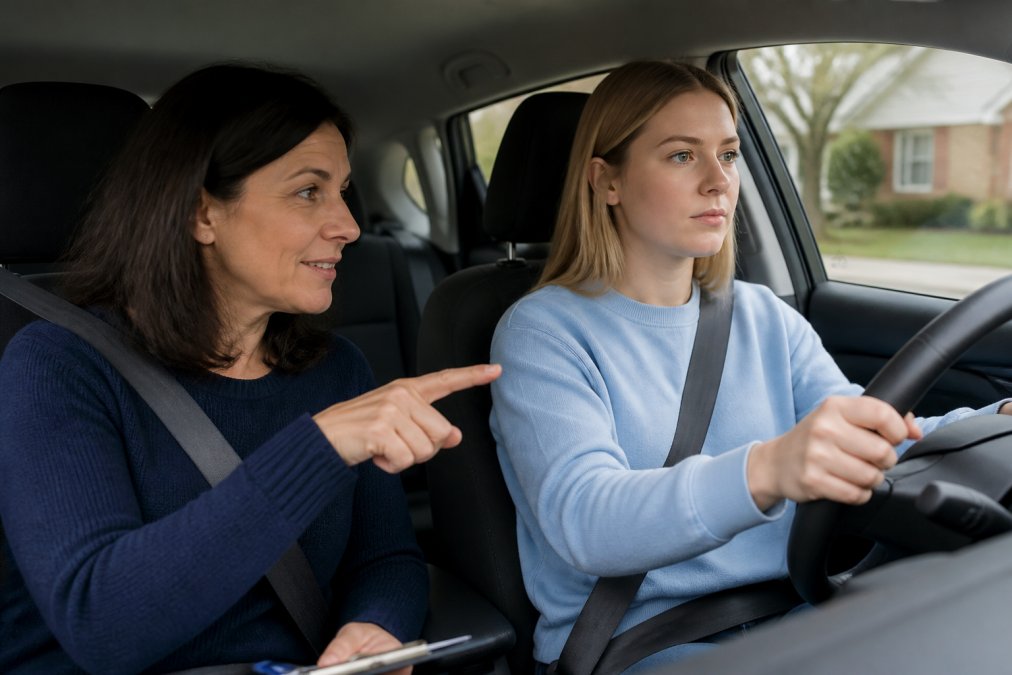
DMV-certified driving instructors are the backbone of any legitimate driver education program. In New York, the DMV regulates driving schools and requires instructors to meet specific training and background check standards (dmv.ny.gov). Choosing a school with certified instructors ensures the curriculum aligns with state-required testing standards and that you learn the correct procedures for your road test.
Without certification, there is no guarantee the instructor understands current licensing requirements or the specific maneuvers the examiner will test. Driving laws and road test routes change, and a certified instructor is required to stay current. This directly affects whether you pass on the first attempt or waste time and money on retests.
Beyond the Certification: Personality and Patience
A certification proves the instructor knows the rules, not that they know how to teach. For adult learners, the instructor’s personality is just as important as their credentials. You need someone who communicates clearly, corrects mistakes without belittling you, and has the patience to let you learn at your own pace.
When you call a driving school, ask to speak directly with the instructor who will be teaching you. A quick conversation before you book can reveal whether their communication style matches your learning needs. If they sound rushed or dismissive on the phone, imagine how they will be in the car.
Specialized Driving Lessons for Nervous Drivers
Driving lessons for nervous drivers are not just a marketing tagline; they are a specific pedagogical approach. Anxiety impairs cognitive function and motor skills (peer-reviewed research). When a student is terrified of merging or parallel parking, they cannot process instructions effectively. A skilled instructor recognizes this and adjusts the lesson to build confidence before tackling complex maneuvers.
Many adults have had a bad experience with a previous instructor who yelled or made them feel foolish, creating a mental block that makes learning harder. Specialized lessons focus on desensitization and incremental progress. The instructor might spend the first session driving around a quiet parking lot, talking through the controls and letting the student get a feel for the vehicle without traffic pressure.
Avoid schools that promise to “fix” nervous drivers in a single intensive session. Building driving confidence takes time. A legitimate program will offer a patient, step-by-step approach that acknowledges your anxiety rather than dismissing it.
Understanding the Cost of Adult Driving School
The cost of adult driving school varies based on your location, the number of hours you need, and whether you require specialized services like pick-up and drop-off or international driver adaptation. Many schools offer packages bundling behind-the-wheel hours with road test preparation, which is often more economical than paying an hourly rate.
When comparing prices, look at what is included. A lower hourly rate might not include the school’s car for the road test or the required pre-licensing course. At White Plains Driving Center, we structure our packages to include road test support so you are not surprised by hidden fees. Since pricing varies by package type and number of lessons, the most accurate way to understand your investment is to request a quote based on your specific skill level and goals.
| Package Type | What’s Typically Included | Best For |
|---|---|---|
| Single Lesson | 1-2 hours behind the wheel | Refresher or skill-specific practice |
| Beginner Package | 5-10 hours + curriculum | New drivers needing structured learning |
| Road Test Package | Lessons + car for test | Nervous drivers needing final prep |
Step-by-Step: From Learner’s Permit to Road Test
Navigating the DMV process is often the most confusing part of learning to drive as an adult. The steps are straightforward if you know where to look. This section walks you through the process from your first DMV visit to holding your full license. Specific requirements vary by state, so always confirm details with your local DMV before you begin.
Step 1: Gather Your Documentation Before You Go
The most common reason adults leave the DMV empty-handed is missing paperwork. Before your visit, assemble the following:
- Proof of identity: A valid U.S. passport or birth certificate. If you are a non-citizen, bring your green card, work visa, or other immigration documents.
- Proof of Social Security number: Your Social Security card or a W-2 form showing your full number.
- Proof of residency: Two documents showing your current address, such as a utility bill, bank statement, or lease agreement. Many states require these to be dated within the last 60 days.
- Payment for the permit fee: Fees vary by state, typically ranging from $30 to $90. Check your state DMV website for the exact amount and acceptable payment methods, many offices do not accept cash.
Make an appointment online before you go. Walk-in wait times at DMV offices can exceed two hours in urban areas, while appointment holders are typically seen within 15 minutes.
Step 2: Pass the Written Knowledge Test
The learner’s permit written test covers traffic laws, road signs, and safe driving practices (nhtsa.gov). It is typically administered on a computer at the DMV office, and you must answer a passing percentage correctly (usually around 70-80%, depending on the state). If you fail, most states allow a retake the same day or after a short waiting period, but there is often a retest fee.
Study materials are available for free on your state DMV website. The official driver’s manual is the definitive source, third-party practice tests are helpful but sometimes contain outdated or state-specific inaccuracies. Focus your study on:
- Road sign recognition (shape and color meanings)
- Right-of-way rules at intersections
- Speed limits in different zones (school zones, residential areas, highways)
- Parking regulations
- Impaired driving laws and penalties
Step 3: Complete the Pre-Licensing Course (If Required)
Many states require new drivers to complete a state-approved pre-licensing course before the road test. In New York, this is the “5-hour course”, a mandatory classroom session covering safe driving attitudes, alcohol and drug awareness, and defensive driving techniques. In other states, the requirement may be a longer driver education course or a certain number of supervised practice hours.
As an adult learner, you may be able to complete this course online rather than in a physical classroom. However, check whether your state accepts online completion certificates for the road test appointment, some states require in-person completion for the certificate to be valid.
Step 4: Practice with a Licensed Adult (If Your State Requires It)
Most states require permit holders to complete a minimum number of supervised practice hours before the road test, commonly 40 to 50 hours, with a portion at night. If you have a licensed adult who can practice with you, log these hours carefully; some states require a signed log sheet. If you lack a practice vehicle or licensed companion, a professional driving school can help you meet this requirement through structured lessons.
Step 5: Schedule and Pass the Road Test
The road test is the final hurdle. You can typically schedule it online through your state DMV portal, but appointment availability can be sparse, in some urban areas, wait times stretch to six weeks or more. Book your test as soon as you feel test-ready, not when you feel perfect. A good instructor will tell you when you are ready and help you schedule the test for a time and location where you are most comfortable.
On test day, bring:
- Your learner’s permit
- Proof of completed pre-licensing course (if required)
- A registered, insured vehicle that passes a basic safety inspection (or confirm your driving school is providing theirs)
- Your glasses or contact lenses if your permit has a corrective lens restriction
Step 6: From Pass to Full License
Once you pass the road test, you will receive a temporary license valid for a few weeks while your permanent license arrives in the mail. If you are under 21, you may receive a restricted license with nighttime driving limitations. Adult learners (21 and over) typically receive a full, unrestricted license immediately, though some states impose a brief probationary period with stricter penalties.
Do not let your learner’s permit expire while you are practicing. Permits are typically valid for 1 to 2 years depending on the state. If yours expires, you will need to retake the written test and pay the fee again. Set a reminder on your phone three months before the expiration date.
The entire process, from your first DMV visit to holding your full license, can take several months for an adult learner who takes weekly lessons and practices consistently. The key is to keep moving forward. Each step is a discrete task you can complete, and each one brings you closer to the independence that comes with a driver license.
Conclusion: Start Driving with Confidence
The path to getting your driver license as an adult is rarely a straight line, but it is a road traveled successfully by thousands of people every year. The key is to find an instructor who understands the unique challenges of adult learning and can turn your anxiety into confidence. At White Plains Driving Center, our DMV-certified instructors have spent over 45 years helping adult beginners, nervous drivers, and international students navigate the road test with clear, calm instruction.
We know your schedule is packed and your time is valuable. That is why we offer flexible scheduling and personalized lesson plans that build confidence at your own pace. Whether you are starting from zero or just need a refresher before the practical exam, we are here to guide you through every step of the licensing process. Book a lesson with White Plains Driving Center today and take the first step toward driving with confidence.
Frequently Asked Questions
Is driving school worth it as an adult?
Yes. A structured adult driving school program is often the fastest way to get licensed. Professional instructors break down complex skills like parallel parking and highway merging into clear steps. They also know exactly what examiners look for on the road test, which helps you avoid common mistakes that lead to failure. For nervous adults, a good school provides the patient, controlled environment needed to build driving confidence without the stress of practicing with a family member.
How long does it take for an adult to learn to drive?
The timeline for learning to drive depends on your prior experience and comfort level. Those who have never driven may need more sessions, while returning drivers might only need a few refresher lessons. A good adult driving school will assess your skills in the first lesson and recommend a personalized plan, so you don’t pay for more hours than you need.
What should adult beginners look for in a driving instructor?
Look for DMV-certified driving instructors who have experience teaching adults, not just teenagers. Patience and clear communication are essential, especially if you feel anxious. Ask about their approach to nervous drivers before booking. A great instructor explains the ‘why’ behind each maneuver, not just the steps. Also confirm the school uses dual-control vehicles for safety and offers lessons that match your skill level and learning pace.
How much do adult driving classes cost?
The cost of adult driving school varies widely based on where you live, the length of the package, and the type of instruction you choose. Pricing depends on quantity, dates, and delivery. It’s best to get quotes from a few local schools and ask what is included, such as pick-up and drop-off or use of the car for the road test.