Table of Contents
- NY Road Test Requirements 2026: What Changed This Year
- Eligibility Requirements for Drivers Under 18 and Adults
- NY DMV Pre-Licensing Course Requirements
- What to Bring to NY DMV Road Test
- Vehicle Requirements and Your Inspection Checklist
- What to Expect During the Road Test
- Common NY Road Test Automatic Failures
- Managing Test Anxiety and Nervousness
- Frequently Asked Questions
Last Updated: September 9, 2026
NY Road Test Requirements 2026: What Changed This Year
The NY state road test requirements 2026 remain largely stable, but the DMV has refined how appointments are scheduled and how the pre-licensing certificate is verified. Passing your road test is the final hurdle between holding a learner permit and earning your Class D driver license.
At White Plains Driving Center, we have prepared thousands of Westchester students for this exact moment since 1978. Below, we break down every requirement, document, and vehicle standard you need to meet, plus the common mistakes that cause automatic failures.
Road test requirements are the specific criteria set by the New York State DMV that every applicant must satisfy before receiving a driver license.
Eligibility Requirements for Drivers Under 18 and Adults
Eligibility differs depending on your age. Drivers under 18 must hold a learner permit for at least six months and complete 50 hours of supervised driving, with 15 of those hours completed in the six months before the road test (dmv.ny.gov). Adults aged 18 and older face no minimum permit holding period but must still complete the required coursework.
Learner Permit and Supervised Driving Rules
Your learner permit is your gateway to the road test, but it comes with strict restrictions. Permit holders under 18 may only drive with a licensed driver aged 21 or older in the front seat. All drivers must complete the five-hour pre-licensing course before scheduling a road test appointment.
Supervised driving hours should focus on varied conditions: highway driving, night driving, and adverse weather.
Skipping supervised driving practice is the single most common reason first-time test takers fail. The examiner is not testing whether you can drive; they are testing whether you can drive safely in traffic you have never seen before.
NY DMV Pre-Licensing Course Requirements
The pre-licensing course, often called the five-hour course, is mandatory for every new driver in New York State. Upon completion, you receive an MV-278 certificate, which is valid for one year from the issue date (dmv.ny.gov). You cannot take your road test without a valid MV-278, and if it expires, you must retake the course.
The course covers defensive driving principles, traffic laws, and the risks associated with alcohol and drug impairment. You can complete this requirement through the DMV or a licensed driving school.
Your MV-278 certificate must be presented at the road test. The examiner will verify it electronically, so bringing a physical copy is non-negotiable.
What to Bring to NY DMV Road Test
Bringing the wrong documents is a guaranteed way to have your appointment canceled on the spot. The DMV requires your learner permit, your MV-278 certificate, and a completed MV-285 road test application form (dmv.ny.gov). You also need proof of identity and residency, including a social security number and date of birth verification.
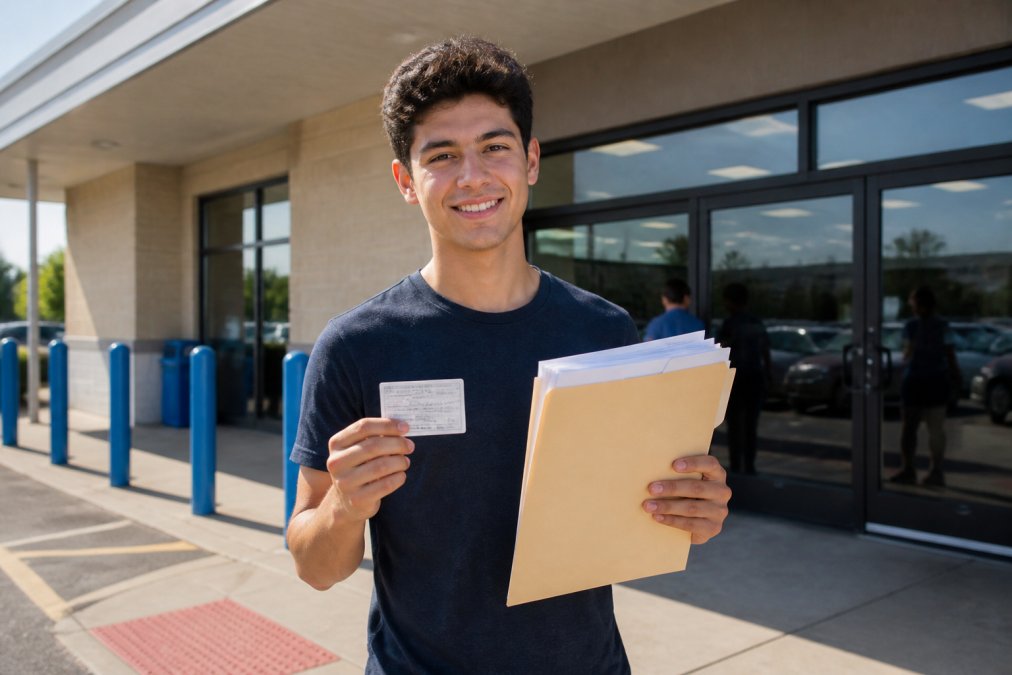
For drivers under 18, a parent or guardian must accompany you to the test site to sign the MV-285 form. If you are 18 or older, you may sign it yourself.
The vehicle you bring must display valid registration and insurance card matching your name or the name of the accompanying licensed driver. Bring the physical insurance card, not a digital copy.
Vehicle Requirements and Your Inspection Checklist
The DMV requires your test vehicle to be safe and legal, but the examiner’s pre-test inspection is more than a formality. A vehicle with a burned-out brake light or a non-functional horn will result in an automatic disqualification. Here is a detailed, student-performed inspection checklist that helps you avoid a wasted trip.
The DMV’s Official Stance
The examiner will check that your vehicle has valid registration and insurance, and that the vehicle is in safe operating condition. This is not a mechanical inspection; it is a safety check. The examiner will ask you to demonstrate that the horn works, the turn signals function, and the brake lights illuminate.
Your Pre-Test Inspection Routine (The Night Before)
Perform this full check the evening before your test, in your driveway or garage, so you have time to fix any issues.
- Lighting Check: With the engine running, turn on the headlights (low and high beams). Walk around the vehicle and confirm both low beams and high beams are working. Then, activate the left turn signal and walk to the rear to confirm the left rear turn signal is flashing. Repeat for the right side. Finally, press the brake pedal and confirm both brake lights illuminate. If you do not have a helper, back up close to a wall or garage door and look for the red glow in the reflection.
- Horn and Wipers: Press the horn to ensure it produces a clear, loud sound. Turn on the windshield wipers and spray the washer fluid to confirm the wipers clear the glass effectively without streaking.
- Seatbelts: Fasten the driver’s seatbelt and ensure it clicks securely. Check the front passenger seatbelt as well, as the examiner will be wearing it. Pull on the belt to confirm the locking mechanism holds.
- Mirrors and Seating: Adjust your interior rearview mirror and both side mirrors so you have a clear view of the road and your blind spots. Adjust the driver’s seat so you can comfortably reach the pedals and see over the steering wheel.
- Dashboard Warning Lights: Start the engine and check the dashboard. Any illuminated warning lights, such as the check engine light, ABS light, or tire pressure light, can be grounds for disqualification. If any light is on, you need to address it before test day.
- Registration and Insurance: Locate the vehicle’s registration and insurance card. The registration must be current, and the insurance card must be the physical paper card, not a digital copy on your phone. The names on these documents must match the name of the driver (you or the accompanying licensed driver).
A common reason for same-day test cancellations is a vehicle with an expired inspection sticker or a registration that does not match the driver’s name. Double-check these documents the night before, not the morning of your test.
What If You Don’t Have a Suitable Vehicle?
Many applicants do not have access to a vehicle that meets all these requirements. Schools like White Plains Driving Center offer road test support that includes the use of a DMV-compliant vehicle. When you book a road test package, you are not just renting a car; you are renting a vehicle that has already passed the examiner’s inspection criteria, allowing you to focus entirely on your driving.
If you are using a friend’s or family member’s car, ask them to review this checklist with you. A simple oversight can cost you your appointment slot and add weeks to your timeline.
What to Expect During the Road Test
The New York road test is a 15-to-20-minute evaluation of your basic driving skills in real traffic. The examiner will direct you through a route that includes residential streets, intersections, and possibly a busier commercial road. You will be asked to perform left and right turns, navigate a four-way intersection, and demonstrate proper lane changes. Parallel parking and a three-point turn are standard components on most routes, so you must practice these maneuvers until they are second nature.
The examiner is not looking for perfection; they are looking for safe, decisive driving. They will assess your observation at intersections, your blind spot checks before lane changes, your speed control, and your ability to maintain proper vehicle positioning. You will lose points for hesitation, such as stopping too long at a stop sign. Conversely, you will fail immediately for aggressive actions like rolling through a stop sign or speeding.
The Examiner’s Score Sheet
The examiner uses a standardized score sheet with categories for speed control, traffic signals, steering, signaling, observation, and vehicle positioning. Minor errors accumulate, and exceeding the allowed number results in a failure. A single major error, such as disobeying a traffic control device, results in an immediate automatic failure. The examiner will not tell you if you passed or failed during the test.
What Happens Immediately After You Pass
When the examiner returns to the test site and confirms you have passed, they will take your learner permit and your MV-278 certificate. They will then issue you an interim license document. This piece of paper is your legal driver license for up to 90 days. It allows you to drive without a supervising driver, but you must carry it with you whenever you are behind the wheel.
The DMV will mail your permanent plastic Class D license to the address on your permit within 2 to 4 weeks. You do not need to do anything to initiate this process. If you do not receive your plastic license within 6 weeks, contact the DMV’s call center. Do not lose the interim document, as it is your only proof of licensure until the plastic card arrives.
Passing the road test is not the end of the process. The interim license is a temporary document, and your permanent license will arrive by mail. Keep the interim document safe and do not drive without it, as a law enforcement officer will accept it as valid proof of your license.
What Happens If You Fail
If you fail, the examiner will provide you with a score sheet that details the errors you made. You are eligible to retake the test immediately, but you must schedule a new appointment. There is no mandatory waiting period between attempts. Use the score sheet as a study guide and focus your practice on the specific areas where you lost points.
Common NY Road Test Automatic Failures
The DMV examiner will end your test immediately if you cause a dangerous situation, disobey a traffic control device, or commit a moving violation. Common automatic failures include running a red light, failing to yield the right of way, and striking a curb during parallel parking.
Speeding, even slightly, is an automatic failure. Driving too slowly can also fail you if it disrupts the flow of traffic. Defensive driving is the core skill being evaluated, not your ability to maneuver the car.
Most test failures stem from nervousness rather than lack of skill, which is why preparation matters as much as practice.
Managing Test Anxiety and Nervousness
Test anxiety is the biggest obstacle for most new drivers. The examiner is not trying to fail you; they are verifying that you can drive safely. Reframing the test as a conversation rather than a performance reduces the pressure significantly.
Arrive at the test site early to acclimate to the area. Take three slow, deep breaths before the examiner enters the vehicle. Speak aloud about what you are doing, such as “checking blind spot before merging,” which both calms you and shows the examiner your awareness.
The students who pass on the first attempt are not necessarily the most skilled drivers. They are the ones who practiced enough that the maneuvers felt automatic, freeing their minds to focus on observation and decision-making.
If anxiety is your primary barrier, consider working with a driving school that specializes in nervous drivers. White Plains Driving Center builds confidence at your own pace, with DMV-certified instructors. Our road test support includes practice on actual test routes and guidance on what the examiner will specifically evaluate.
Passing your NY road test comes down to preparation, documentation, and composure. The NY state road test requirements 2026 are clear: complete your pre-licensing course, hold a valid permit, bring the right documents, and drive a safe vehicle. Master the basics of defensive driving, practice until the maneuvers are second nature, and manage your anxiety with structured preparation. White Plains Driving Center has guided drivers in Westchester since 1978, offering pre-licensing classes, flexible scheduling, and road test support from DMV-certified instructors who understand what the examiner expects. Book your first lesson and approach your road test with the confidence that comes from real preparation.
Frequently Asked Questions
What are automatic fails on a road test in NY?
NY road test automatic failures include causing a collision, disobeying traffic signs or signals, driving too fast for conditions, failing to yield the right of way, and committing a dangerous action that requires the examiner to intervene. You also automatically fail if you exceed the speed limit by more than 10 mph or refuse to follow the examiner’s instructions. The examiner stops the test immediately when any of these occur.
Can you fail parallel parking and still pass in NY?
Yes, you can fail parallel parking and still pass in New York, as long as it is not an automatic failure. The examiner evaluates your overall driving performance. Minor parking errors, like bumping the curb or needing an extra adjustment, count as deductions but do not automatically end the test. You need to score at least 30 out of 50 points to pass, so strong performance in other areas can offset parking mistakes.
What documents must I bring to my NY road test appointment?
You must bring your learner permit, the MV-278 certificate proving you completed the 5-hour pre-licensing course, a completed MV-285 certificate of supervised driving (if you are under 18), and your road test appointment confirmation. Your supervising driver must also bring their valid driver license. If any document is missing, the DMV will cancel your appointment and you will need to reschedule and pay the fee again.
Do I need to complete a pre-licensing course before my road test?
Yes, every new driver under 18 must complete the 5-hour pre-licensing course and hold the MV-278 certificate before taking the road test. If you are 18 or older, you also need the MV-278 unless you completed a high school or college driver education course approved by the DMV. You must present the certificate at your road test appointment or the examiner will refuse to conduct the test.
How do I schedule a road test appointment in NY for 2026?
You can schedule your NY road test online through the DMV website once you meet all eligibility requirements. You must have held your learner permit for at least six months, completed the pre-licensing course, and, if under 18, finished 50 hours of supervised driving. The DMV releases appointment slots in batches, so check the website regularly. You can also schedule by phone at 1-518-402-2100.
What is the most common reason for failing a driving test in NY?
The most common reasons for failing a NY road test are poor observation and failing to check blind spots, especially during lane changes and turns. Many test-takers also fail for not coming to a complete stop at stop signs or for rolling through intersections. Inadequate steering control and improper lane positioning are also frequent issues. Consistent practice with a certified instructor helps build these habits before test day.