Table of Contents
- Start With the Right Supervisor: Who Can Supervise a Permit Driver
- Plan a Progressive Practice Schedule: How Many Hours to Practice Driving Before a Road Test
- Where to Practice Driving as a Beginner: Low-Traffic Locations That Build Skill
- Your Adult Driving Practice Checklist: What to Master Before the Road Test
- How to Practice Driving With a Permit as an Adult on Public Roads
- Insurance, Vehicle, and Legal Liability for Adult Permit Practice
- Frequently Asked Questions
Last Updated: October 8, 2026
Start With the Right Supervisor: Who Can Supervise a Permit Driver
Learning to practice driving with a permit as an adult starts with your supervising driver: in most states, a licensed adult, usually 21 or older, who has held a full license for at least a year.
Every state sets its own rules, so check your state DMV handbook before your first practice trip.
state driver licensing requirements
Age, License, and Seat Requirements for Supervising Adults
Rules vary by state, but the pattern is consistent: a supervising driver is typically a licensed adult, 21 or older, in the front passenger seat, sometimes with a minimum license-holding period.
A few points to confirm in your state handbook:
- Minimum age of the supervisor (often 21)
- How long they must have held a full license
- Whether they must sit in the front passenger seat
Adult permit holders sometimes follow different rules than teens: in several states, adults over 18 face fewer restrictions and shorter holding periods.
How to Choose a Calm, Qualified Supervising Driver
Pick someone patient. This matters more than experience behind the wheel.
A nervous supervisor transfers their tension to you. You grip the wheel harder. You brake too early. The whole lesson falls apart.
Look for a supervisor who:
- Stays quiet unless there is a real problem
- Gives one instruction at a time
- Has driven for years without incidents
If a family member makes you anxious, ask someone else. A professional instructor is a strong option for adults who want structured, calm guidance. At White Plains Driving Center, our DMV-certified instructors build lessons around your pace.
Agree on a signal before you start. A simple tap on the dashboard can mean “pull over when safe.” This gives you a way to pause without panic.
Plan a Progressive Practice Schedule: How Many Hours to Practice Driving Before a Road Test
Most states require supervised practice hours before your road test, commonly 50 total, with 10 at night, though some require 40, 60, or no fixed number.
The number on paper matters less than the quality of each session. Many adult learners log 50 hours of highway cruising and still fail because they never practiced parallel parking or a three-point turn under pressure.
A Session Structure That Actually Builds Skill
Every practice drive should follow the same five-part shape professional instructors use:
- Pre-brief (5 minutes): State the one skill you are working on today. “Today is lane changes.” Nothing else.
- Warm-up (5-10 minutes): Drive a route you know well to settle your hands and your supervisor’s nerves.
- Focused drill (15-25 minutes): Repeat the target skill in low-stakes conditions. Ten lane changes on a quiet road beats two on a busy one.
- Integration (10-15 minutes): Use the skill in real traffic until it becomes automatic.
- Debrief (5 minutes): Park, turn the engine off, and name one thing that went well and one to fix next time, before you drive home, not after.
An 8-Week Adult Practice Plan
This plan assumes three sessions per week at 45-60 minutes each, roughly 20-24 hours of focused practice. Add longer weekend drives to reach a 50-hour state requirement.
| Week | Primary Skill | Session Focus | Move On When… |
|---|---|---|---|
| 1 | Vehicle control | Empty lot: steering, smooth braking, seat and mirror setup | You can stop without lurching and hold a straight line |
| 2 | Low-speed maneuvers | Parking lot: three-point turns, straight-line backing, pull-in parking | You complete each maneuver without a supervisor correction |
| 3 | Residential streets | Turns, stop signs, right-of-way, scanning intersections | You check mirrors and blind spots without being reminded |
| 4 | Traffic basics | Lane position, following distance, reading signs early | You maintain a 3-second gap without prompting |
| 5 | Lane changes and merging | Mirror-signal-blind-spot sequence, on-ramps | You complete 10 clean lane changes in a row |
| 6 | Parking mastery | Parallel parking, angled parking, hill parking | You park within one attempt on a quiet street |
| 7 | Night and weather | Headlights, high beams, reduced visibility, wet roads | You drive 30 minutes at night without a correction |
| 8 | Road test simulation | Full route at test speed, examiner-style scoring | You complete the route with zero safety-critical errors |
How to Track Hours and Progress
Many states require a signed, dated log of supervised hours, sometimes with the supervisor’s signature on each entry.
A simple log needs five columns: date, start and end time, total hours, skills practiced, and supervisor signature.
Beyond the legal log, keep a private skills journal: after each session, note one thing that felt automatic and one that still required thought.
Schedule your road test for a week after your last planned practice session, not the day after. A short buffer lets you do one calm review drive without the pressure of a test hanging over it.
Do not count hours spent as a passenger, hours driving without a licensed supervisor, or hours behind the wheel of a vehicle you are not insured to drive. If a state auditor or examiner questions your log, those hours can be disallowed and your test date pushed back.
Track hours in a notebook or app, but keep a paper backup, a dead phone battery on test day is a bad reason to lose credit for 50 hours of work.
Where to Practice Driving as a Beginner: Low-Traffic Locations That Build Skill
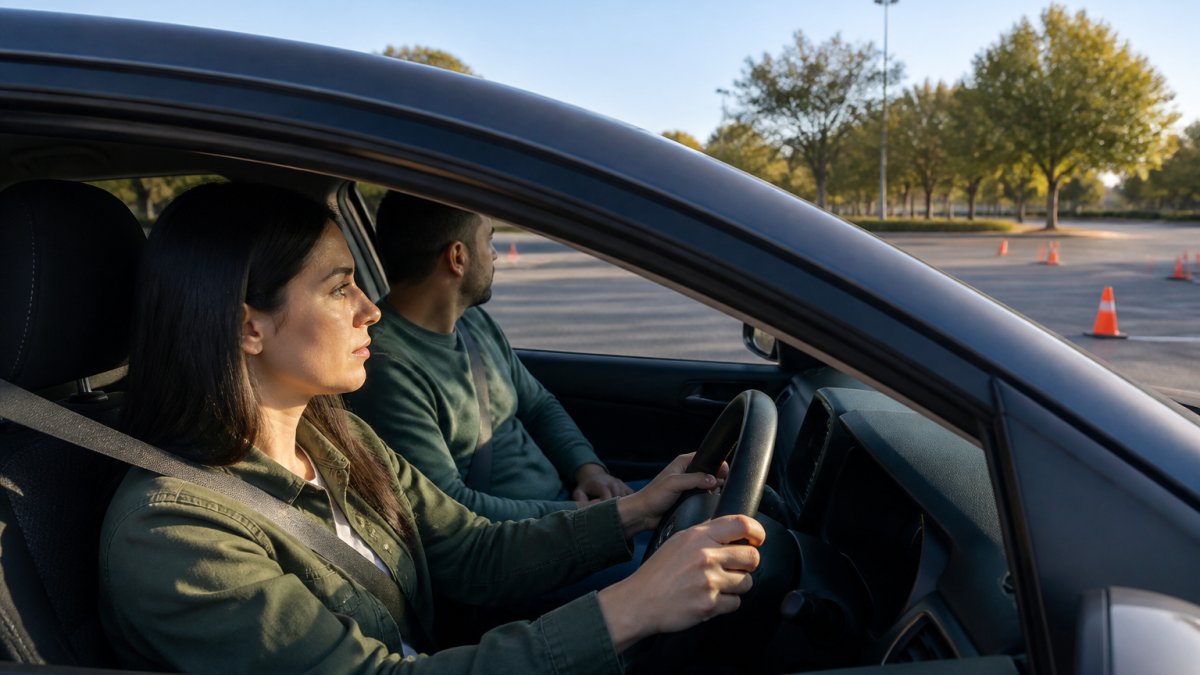
Start where nothing can hit you: empty parking lots, quiet residential streets, and industrial parks on weekends give you room to make mistakes without consequences.
The Pre-Drive Checklist (Do This Every Single Time)
Before you leave the driveway, run the same 90-second sequence, it prevents most avoidable incidents.
- Vehicle check: Walk around the car for children, pets, bikes, and obstacles. Check that both mirrors are clean and the tires are not visibly flat.
- Cabin setup: Seat adjusted so your knee stays slightly bent when the brake is fully pressed. Mirrors set so you can see a sliver of your own car in the side mirrors. Headrest at ear level.
- Controls check: Locate the hazard lights, parking brake, defroster, and wipers before you move, you do not want to hunt for them in rain.
A Location Progression With Drills for Each Stage
Build your location list in this order, and give each stage a specific drill.
Stage 2, Residential streets. Speed limits are usually 25 mph or lower.
Stage 3, Business parks on weekends. Wide lanes, few cars, predictable layouts.
Stage 4, Quiet two-lane roads. Drills: handling oncoming traffic on narrow roads; passing parked cars; maintaining speed on gentle curves.
Stage 5, Main roads during off-peak hours. Aim for 10 a.m. to 2 p.m. on weekdays.
What to Do When Something Goes Wrong
Mistakes are the point of practice. What matters is how you and your supervisor handle them.
- You miss a turn or exit. Do not swerve or brake hard. Continue to the next safe turn and reroute. Missing a turn costs 30 seconds; a panic maneuver can cost far more.
- You stall or freeze at an intersection. Take a breath, restart the car if needed, and proceed when the way is clear. If you need more time, wave the other driver through.
- Your supervisor grabs the wheel or shouts. Pull over at the next safe spot and reset. A supervisor who overrides your control is a safety risk, not a coach. Consider a different supervisor or a professional instructor.
Do not jump to highway driving before you can hold a steady lane and check mirrors without thinking. Highway speeds leave no room for hesitation, and a single panicked merge can end a practice session badly. Most instructors recommend at least 15-20 hours of surface-street practice before your first highway session.
The best practice location is the one where you can make a mistake, learn from it, and drive home calm. If a location makes you tense, it is the wrong location for today, not a sign you are not ready to drive.
Your Adult Driving Practice Checklist: What to Master Before the Road Test
Use this checklist to track real skills, not just hours. Check off each item only when you can do it smoothly, without prompting.
Core Vehicle Control and Traffic Skills to Drill
- Smooth acceleration and braking
- Steering with both hands, no sudden jerks
- Straight-line backing and three-point turns
How to Track Progress and Know You Are Ready
You are ready when a full practice drive feels routine, not dramatic, finishing a session without a single correction from your supervisor is your signal. Keep a simple log with three columns: date, skills practiced, and what felt hard. Review it weekly; patterns show up fast.
The road test rewards calm, predictable driving, not perfect driving. Examiners look for safe habits, not flawless execution.
How to Practice Driving With a Permit as an Adult on Public Roads
Public roads are where everything comes together. Before you turn the key, run a short pre-drive check: seat and mirrors set, seatbelt on, phone away, and a planned route in mind.
During the drive, follow this loop:
- Scan the road 12-15 seconds ahead
- Check mirrors every 5-8 seconds
- Call out hazards out loud to your supervisor
- Keep both hands on the wheel
- Pause at any point you feel overwhelmed
Plan each practice trip with one goal, today lane changes, tomorrow parking. One goal per drive keeps your attention sharp.
Adult permit holders in many states can drive on public roads only with a licensed adult in the front seat. Confirm your state’s permit restrictions before you leave the driveway.
DMV permit and license rules
Insurance, Vehicle, and Legal Liability for Adult Permit Practice
Check your auto insurance before the first practice drive. Most policies cover a permit holder driving with a licensed adult, but confirm it in writing with your insurer.
A few things to sort out early:
- Add the learner to the policy if your insurer requires it
- Confirm the practice vehicle is registered and insured
- Make sure the supervisor is legally allowed to supervise in your state
If you practice in someone else’s car, ask about their coverage too. Liability follows the vehicle in most cases, but rules differ by state.
Driving without a licensed supervisor, or outside your permit restrictions, can lead to fines and a delayed license. In some states it can reset your permit holding period.
If the paperwork feels confusing, a driving school can help. White Plains Driving Center has guided adult and international drivers through these steps.
Learning to drive as an adult takes courage, especially if you feel anxious or are adjusting to new road rules.
Frequently Asked Questions
Can adults practice driving with a learner’s permit?
Yes. In most states, adults can get a learner permit and practice driving as long as a licensed driver who meets the state’s age and license requirements sits in the front passenger seat. You must follow all permit restrictions, including supervised driving only. If you drive alone with a permit, you can face fines, license suspension, and insurance problems. Check your state DMV for the exact rules that apply to adult permit holders.
How many hours should an adult practice before a road test?
Many states require 40 to 50 hours of supervised practice, including 10 hours at night, before a road test. Adults often need fewer hours than teens but should still log consistent practice across different conditions. Aim for at least 20 to 30 hours of focused sessions covering parking, lane changes, and highway driving. Track your hours in a log and review weak skills with your supervisor before scheduling the test.
Can an adult with a permit practice driving in their own car?
Yes, as long as the vehicle is registered, insured, and meets your state’s safety requirements. The supervising driver must sit in the front passenger seat and hold a valid license. If you practice in your own car, confirm your insurance policy covers a permit holder driving it. Some policies only cover licensed drivers, so call your insurer before your first practice trip to avoid gaps in coverage.
Where can an adult practice driving with a permit?
Start in low-traffic areas like empty parking lots, residential streets, and quiet industrial roads. As your control improves, move to main roads, intersections, and eventually highways during daylight. Avoid busy rush-hour traffic until you can steer, brake, and check mirrors smoothly. Supervised practice on public roads is allowed with a permit in most states, but always follow your state’s permit restrictions and never drive alone.