Table of Contents
- Why International Students Need Specialized Driving Instruction
- How to Get a Driver’s License as a Non-Citizen in New York
- Understanding the NY DMV 5-Hour Pre-Licensing Course
- Behind-the-Wheel Training: What to Expect
- Adapting to U.S. Driving Laws and Road Conditions
- Cost of Private Driving Lessons and Package Options
- Road Test Preparation for International Drivers
- How Flexible Scheduling Works for Busy Students
Last Updated: August 16, 2026
Why International Students Need Specialized Driving Instruction
Getting a driver’s license as an international student means navigating unfamiliar regulations, adapting to different road conditions, and managing the stress of testing in a new country. Road markings, turn signals, lane widths, and intersection etiquette differ from home. A driver confident on familiar roads can feel disoriented facing a four-way stop or left turn across oncoming traffic for the first time.
White Plains Driving Center has worked with international students for decades. The pattern is consistent: students who receive specialized instruction adapted to their background pass their tests faster and with greater confidence. The key is an instructor who understands not just what you need to learn, but what you’re unlearning from your previous driving experience.
This guide walks you through every step of obtaining your license as an international student, from documentation requirements through road test preparation.
How to Get a Driver’s License as a Non-Citizen in New York
Becoming a licensed driver in New York as a non-citizen involves a specific sequence of steps. You cannot skip steps or combine them; the DMV process is linear.
Documentation Requirements
The DMV requires proof of identity, proof of Social Security number, and proof of residency.
Identity proof can be your passport or consular ID. Bring the original document; photocopies don’t work for initial applications.
Social Security number is where many international students get stuck. If you have a valid Social Security Number (SSN), bring the card or official documentation. If you don’t have one, you’ll need an Individual Taxpayer Identification Number (ITIN). The process takes weeks, so start early if you don’t already have one. The SSN/ITIN requirement is non-negotiable.
Proof of residency is the trickiest part for international students. The DMV accepts:
- A lease agreement or mortgage statement with your name and address
- A utility bill in your name
- A letter from your school on official letterhead confirming your enrollment and residential address
- Bank statements showing your address
If you live in student housing, contact your residential life office; they can often provide an official letter confirming your residency. Bring originals and one photocopy of each document.
Learner Permit Process
Once you’ve gathered your documentation, visit your local DMV office. You’ll fill out Application for a Learner Permit (Form MV-44) and take a written test covering traffic laws, road signs, and safe driving practices. The test has 20 questions; you need to answer at least 14 correctly to pass.
After passing, you’ll have your learner permit, valid for five years. With this permit, you can drive only when a licensed driver 21 or older is in the front passenger seat.
Understanding the NY DMV 5-Hour Pre-Licensing Course
New York State requires all first-time driver’s license applicants to complete a 5-hour pre-licensing course before taking the road test. This is mandatory and you cannot test without proof of completion.
What the Course Covers
The 5-hour course is standardized across all approved providers and covers traffic laws specific to New York State, safe driving practices, hazard awareness, impaired driving awareness, aggressive driving recognition, distracted driving, and seat belt and child safety requirements.
The course is classroom-based or online. White Plains Driving Center offers both formats.
How It Prepares You for the Road Test
The pre-licensing course teaches the rules and expectations of driving in New York. The road test examiner will expect you to know these rules and apply them during your test. The course covers specific New York regulations that differ from other states or countries, such as right turns on red lights, which are allowed in most cases but not everywhere.
Behind-the-Wheel Training: What to Expect
Behind-the-wheel training is where you adapt your muscle memory and instincts to American roads.
Dual-Brake Vehicles and Safety
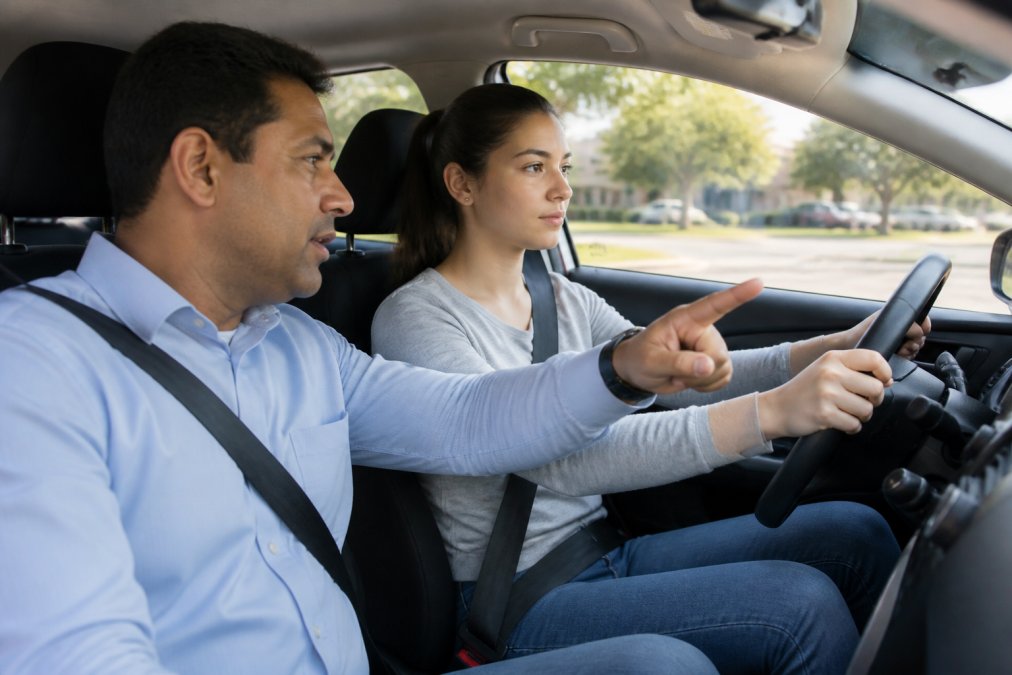
All professional driving instruction vehicles are equipped with dual-brake systems. The instructor has a brake pedal on the passenger side, allowing them to stop the vehicle if necessary. This safety feature allows you to focus on learning without worrying about safety. If you make an error in judgment, the instructor can intervene, allowing you to practice in real traffic conditions while maintaining a safety net.
Automatic vs. Manual Transmission Lessons
Most driving instruction in the United States uses automatic transmission vehicles. If you learned to drive on a manual transmission, this is a significant shift. The New York road test can be taken in either an automatic or manual vehicle, but you’ll be restricted to automatic transmission only if you test in an automatic.
If you plan to drive automatic vehicles in the United States, your lessons should be in an automatic. Your muscle memory needs to match your test vehicle.
Adapting to U.S. Driving Laws and Road Conditions
American driving culture and rules differ significantly from many home countries. These differences are fundamental to how the road test examiner will evaluate your performance.
Right turns on red lights are legal in New York (with exceptions), but many countries prohibit this entirely. You need to learn to make a complete stop, check for pedestrians and oncoming traffic, and turn right when safe.
Four-way stops don’t exist in many countries. The rule is simple: first vehicle to arrive has the right of way; if two vehicles arrive simultaneously, the vehicle on the right has the right of way.
Speed limits are posted in miles per hour. Highway speeds, residential zone speeds, and school zone speeds all have specific limits and enforcement patterns.
Lane discipline is stricter in the United States than in many countries. Drifting between lanes or treating lane markings as suggestions will result in immediate test failure.
Cost of Private Driving Lessons and Package Options
Pricing for driving lessons varies depending on the package, the number of hours, and the specific services included. For current pricing and available package options, visit the White Plains Driving Center website or contact the office directly.
Many international students find that bundled packages, which combine the pre-licensing course, behind-the-wheel lessons, and road test preparation, provide better value than purchasing services separately.
Road Test Preparation for International Drivers
The New York DMV road test lasts approximately 20 minutes. The examiner evaluates your ability to operate the vehicle safely and follow traffic laws.
Common Mistakes to Avoid During the Exam
Failing to come to a complete stop. In many countries, a rolling stop at a stop sign is acceptable. In New York, it’s an automatic failure. You must come to a complete stop before proceeding.
Not checking mirrors and blind spots. Check your mirrors before every maneuver, before turning, before changing lanes, before merging. The examiner wants to see that you’re aware of your surroundings constantly.
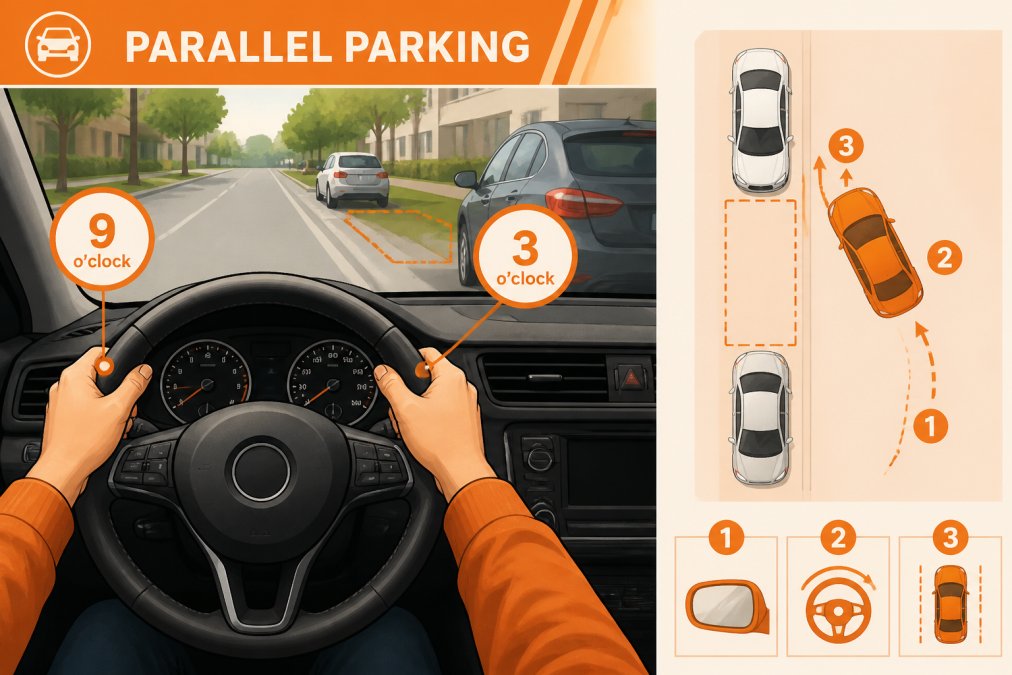
Incorrect hand position on the steering wheel. The standard in the United States is hands at 9 and 3 o’clock. Your instructor will correct this early, but practice extensively so you don’t revert under stress.
Hesitation at intersections. Excessive hesitation signals uncertainty to the examiner. Be decisive while remaining safe.
Improper lane positioning. Stay centered in your lane. Lane discipline is evaluated throughout the test.
Maneuverability Skills: Parallel Parking and Intersection Navigation
Two skills separate students who pass from those who don’t: parallel parking and intersection navigation.
Parallel parking is tested on every New York road test. Two cones are placed 5 feet apart. You must park your vehicle between these cones without hitting them and without making more than three attempts. Most students accomplish this with 10-15 practice attempts. The technique is consistent: pull alongside the front cone at a 45-degree angle, reverse while turning the steering wheel fully to the right, straighten the wheels when the vehicle is mostly in the space, and adjust as needed.
Intersection navigation is tested throughout the road test. At a left turn across oncoming traffic, wait for a clear gap. At a right turn on red, come to a complete stop, check for pedestrians and oncoming traffic, and turn only when safe. At a four-way stop with another vehicle, yield to the vehicle on your right if you arrive simultaneously.
These skills require practice in real traffic. Your instructor will gradually increase complexity, starting with quiet residential streets and progressing to busier roads and highway-speed roads.
How Flexible Scheduling Works for Busy Students
International students often juggle work, school, and visa requirements. White Plains Driving Center offers flexible scheduling specifically for this population.
Lessons can be scheduled around your work hours, class schedule, and other commitments. Whether you need early morning lessons before work, evening lessons after class, or weekend lessons, scheduling can be arranged.
Many international students benefit from scheduling lessons in a sequence, for example, three lessons per week for four weeks, rather than sporadic lessons. This consistency builds skill faster and keeps muscle memory sharp.
Getting your driver’s license as an international student requires adapting to a new driving culture, understanding unfamiliar regulations, and building confidence in an unfamiliar environment. White Plains Driving Center specializes in exactly this challenge. With DMV-certified instructors who understand the specific obstacles international students face, flexible scheduling that works around your life, and comprehensive preparation covering everything from the 5-hour pre-licensing course through road test strategy, you’re getting a partner in the licensing process. Book your first lesson today and take the first step toward driving with confidence on American roads.
Frequently Asked Questions
What documents do international students need to get a learner's permit in New York?
International students must provide proof of identity (passport), proof of residency (lease or utility bill), and a completed DMV application. Social Security Number is required unless you qualify for an ITIN. Some students may need to provide visa documentation or I-20 forms depending on immigration status. Contact the DMV or your driving school to confirm all requirements for your specific situation, as documentation can vary based on citizenship status.
Is the NY DMV 5-hour pre-licensing course mandatory for international students?
Yes, the 5-hour pre-licensing course is required for all first-time driver's license applicants in New York, including international students. The course covers traffic laws, road signs, defensive driving, and safe driving practices. It must be completed before you can schedule your road test. Many driving schools offer this course in-person or online, and completion is documented with a certificate you'll present at the DMV.
How long does it typically take to get a driver's license after starting driving lessons?
The timeline depends on your prior driving experience and how quickly you progress. Most international students complete the 5-hour pre-licensing course within one or two weeks, then schedule behind-the-wheel lessons. With consistent practice, many students are road-test ready within 4-8 weeks. However, if you're adapting to U.S. driving rules for the first time, you may need additional lessons to build confidence with different traffic laws and road conditions.
Can I use my international driver's license or permit to take driving lessons?
Your valid international or foreign driver's license can help you obtain a learner's permit in New York, but you cannot legally drive without a valid permit or license. Once you hold a learner's permit, you can take driving lessons with a licensed instructor. An International Driving Permit is not required for lessons, but your foreign license and passport serve as important identification documents during the application process.
This article was written using GrandRanker